Hey Team,
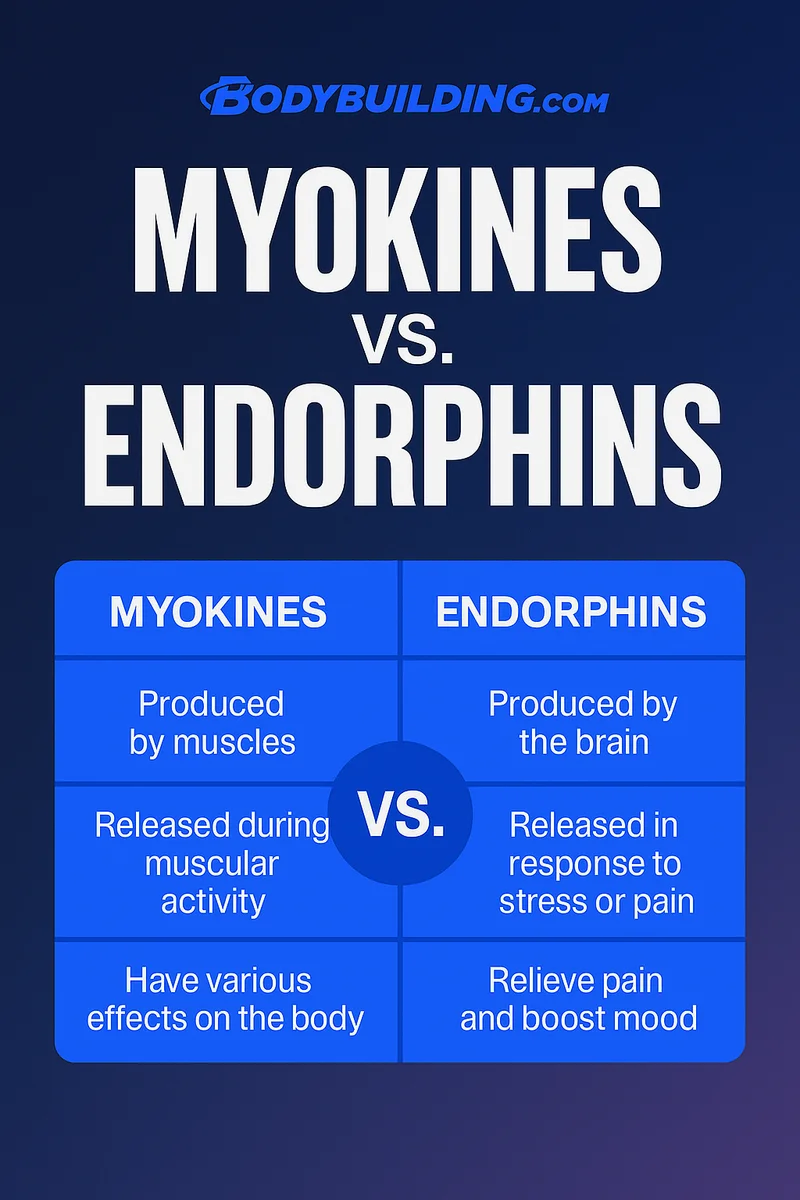
Today we’re breaking down the difference between myokines, a class of proteins that are released by muscle fibers in response to exercise, and endorphins, hormones produced by the brain and nervous system that aid in stress reduction and mood.
Myokines serve as signaling molecules, playing a key role in how muscles communicate with other organs throughout the body. When we exercise — lifting, running, biking, etc., muscles actively release myokines into the blood. From there, myokines travel and send signals to the brain, fat cells, immune system and the skeletal and cardiovascular systems.
Here’s an example of what those signals can say:
🧠 To your brain: "Feel good!" (they can help improve mood and reduce depression)
🥓 To fat tissue: "Burn more fat!"
🦴 To bones: "Get stronger!"
🦠 To the immune system: "Get ready to fight infections!"
Myokines contain the subcategories with separate functions that follow:
- IL-6 = Aids fat burn and controls sugar levels
- Irisin = Transitions “bad” fat to “good” fat that burns more energy
- BDNF = Boosts brain and memory
- IL-15 = Builds and protects muscle
- Myostatin = slows down muscle growth (exercise lowers this)
Endorphins, on the other hand, are the happy chemicals released in response to exercise. We often hear this referred to as “runner’s high” in the endurance community or the recognizable feeling of joy after a solid lift. The purpose of endorphins is to relieve pain and boost pleasure through the function of hormone release.
Unlike myokines and their ability to restore metabolic balance to your muscles, endorphins surge during high-intensity or prolonged exercise. They can immediately provide mood-lifting and pain-reducing effects that further contribute to motivation and the healthy addiction to daily exercise.
When you work out, endorphins make you feel good now, while myokines help keep your body strong later. Whatever the goal, keep moving.
Until next time. 👋