Hey, happy Saturday. There’s a lot going on, so we’re delivering a special Saturday edition with all the latest, starting with the revelation that four reporters for The New York Timeshave been subpoenaed by the Justice Department.
Agents on the doorstep
When President Trump claimed on Wednesday that he was sending the new Qatari-gifted Air Force One to England so that US service members could “tour the Aircraft,” everyone knew there was more to the story.
His claim was immediately undermined by sources and security experts. The New York Times’s headline read: “Security Precaution Led Trump to Use Old Air Force One in Leaving Turkey.”
There were follow-up stories on Thursday. Trump was left “fuming,” according to CNN’s Kaitlan Collins and Kevin Liptak. They reported today that Trump was “embarrassed and angry in recent days when it became public that the plane was not equipped enough to be flown directly from the NATO summit in Turkey back home.”
So, this was personal for the president. That’s crucial context for what came next.
On Friday, according to CNN’s Evan Perez and Kristen Holmes, FBI director Kash Patel met with officials at the White House “to discuss the bureau’s investigation” into the disclosures about the plane security concerns. By then, a leak hunt was apparently already underway.
Patel didn’t leave the White House campus until 6:44 p.m. ET. Later in the evening, the four Times reporters received court orders to testify “in regard to an alleged violation of federal criminal law.”
“In some cases, the subpoenas were delivered by federal agents who showed up at reporters’ homes,” wrote Times media reporter Michael Grynbaum, who broke the news shortly after midnight.
Grynbaum reported that the subpoenas were issued by Jay Clayton, US Attorney for the Southern District of New York, who is in line to become Trump’s director of national intelligence.
In other instances, news organizations have received subpoenas and kept the matter a secret, preferring to fight the court orders behind the scenes. But the Times decided to publicize the threat immediately.
“This brazen act should be seen as nothing more than an attempt to prevent the public from knowing what is happening in their country by intimidating journalists from doing their jobs,” David McCraw, the Times’ top newsroom lawyer, said in a statement.
The subpoenaed journalists — Julian E. Barnes, Eric Lipton, Tyler Pager and Eric Schmitt — will not be intimidated. I expect the Times will fight the court order. This may unfold relatively quickly, since the order seeks to force them to testify before a federal grand jury on Wednesday.
“When federal agents arrive at the homes of journalists with subpoenas, it is not ordinary law enforcement,” National Press Club president Mark Schoeff said this morning. “It is an extraordinary assault on the freedom of the press that strikes at the heart of the First Amendment.” Here’s our full story for CNN.com.
Serious security questions
“To be fair, this kind of story about Air Force One defensive security measures would probably trigger a leak investigation in any administration,” a reporter who’s been covering this topic told me today. “But not every administration would take shortcuts on security upgrades required for Air Force One as this one appears to have done. That’s a legitimate story.”
Trump was “eager to show off the Qatari plane,” the reporter pointed out. “That they allegedly flew him on this plane without all the security upgrades is a scandal, and the public has a right to know that apparent shortcuts are being taken that could affect the continuity of our government.”
I granted the reporter anonymity since they didn’t have permission from their employer to analyze the situation on the record.
Highlighting Trump’s dishonesty
When the government’s official account is contradicted by sources inside the government, it really highlights the dishonesty of the official line.
It also highlights the pressure that Trump appointees face – pressure to follow up on his grievances. When the president pushed the Justice Department to subpoena reporters over alleged Iran war leaks last spring, he wrote the word “Treason” in Sharpie atop a stack of printed articles and handed it to Todd Blanche.
The articles were not treasonous, but reporters from the Wall Street Journal and Washington Post were targeted nevertheless. The DOJ withdrew those subpoenas after a secret legal fight.
As the Post’s Perry Stein wrote here, “subpoenas to testify present professional risks for the reporters involved. Most news organizations follow strict guidelines to protect confidential sources. If they are forced to appear before a grand jury, prosecutors can ask them to identify those sources under penalty of contempt of court or obstruction of justice charges.”
That’s what the Times has to navigate now.
Seth Stern, chief of advocacy at the Freedom of the Press Foundation, said today that “when the government claims it needs to investigate journalists to protect national security, it really means its own reputational security. This is as clear an example as you can get.”
Trump said one thing, trustworthy sources said another, and newsrooms recognized that the dispute was newsworthy. This has happened so many times in the Trump era that it’s impossible to count them all. The difference, this year, is that DOJ officials are sending out subpoenas in response.
“The subpoenas are an extraordinary escalation in President Trump’s efforts to threaten and intimidate independent news organizations, and have a chilling effect on the work of journalists across the country,” CPJ CEO Jodie Ginsberg said this morning.
A DOJ spokesperson said in a statement that “reporters are not the targets, those leaking classified information are,” which is the same justification that was used for the WSJ and WaPo subpoenas.
“We value and appreciate the important role that the press plays in this country, but D.O.J. also plays an important role to make sure that the people entrusted with our nation’s secrets do what they’re supposed to do with that information,” the spokesperson said.
Related, or not…
This afternoon, the president posted another screed about Times reporter and “Regime Change” co-author Maggie Haberman, arguably the single best-sourced reporter inside the Trump White House.
“Her book is a joke!” he wrote. “90% of it is Fake News. She has made a living off her bad reporting, and will pay the price when our Multi Billion Dollar Lawsuit against The Failing New York Times gets to Court, which should not be that long. I don’t mind bad press, if they are right. I do mind Fake Reporting, like what’s in her boring book…”
Then he went on about his “perfect physical” at Walter Reed, and said Haberman and her co-author Jonathan Swan would fail the cognitive test he “aced.”
“Anyway,” the president wrote, “don’t buy their book, it’s garbage!”
“Regime Change” remains #1 on Amazon’s new releases bestseller list. The book sold out almost everywhere last month, but Simon & Schuster is restocking bookstores as quickly as it can…
In other news…
Oregon AG teases ‘next steps’ after withdrawing motion against Paramount
Last night, Paramount said Oregon state attorney general Dan Rayfield had withdrawn his court motion that sought to obtain certain documents and a 60-day pause of the Paramount–WBD deal. “We are pleased that the Oregon Attorney General has withdrawn its motion to delay this transaction. It was the right decision and avoids an unwarranted effort to delay a lawful, pro-competitive merger,” a Paramount rep told me.
It might seem counterintuitive, but the Oregon AG’s move is consistent with his plan to join other states in challenging Paramount–WBD on antitrust grounds. Those states are moving to file suit in the coming days (as I reported here), and the Oregon court motion would be superseded by the multi-state suit anyway.
Read between the lines of what the Oregon AG’s spokesperson said last night: “Paramount made it clear that they weren’t going to comply with the investigative demand, and that they think they’re above the law. We’re not going to let them waste Oregonians’ resources on these games. We’ve withdrawn the motion to consider our next steps.”
–
Meta yanks new AI image feature
After several days of objections and outrage, Meta has pulled back, pausing a new AI feature on Instagram “that allowed users to generate images based on people’s public accounts,” Eli Tan reported for the Times.
Puck’s Dylan Byers broke the news on X. SAG-AFTRA’s reaction: “A win is a win. 💪 Following widespread backlash — including SAG-AFTRA’s call for members to opt out — Meta has withdrawn the feature.”
Apple sues OpenAI
A monumental legal face-off: “Apple sued OpenAI on Friday, alleging the AI company has stolen the iPhone maker’s trade secrets to develop its own yet-to-be-unveiled AI gadgets,” CNN’s Lisa Eadicicco and Hadas Goldwrote.
“The explosive allegations set up what is likely to become a titanic battle between one of the tech industry’s most powerful legacy companies and one of its fastest-growing up-and-comers,” WaPo’s Gerrit De Vynckwrote.
Journalists attacked in West Bank
In the occupied West Bank today, “Israeli settlers armed with clubs, rocks and a knife blocked our way and attacked us and another group of journalists,” CNN’s Jeremy Diamond reported.
Israel Police said four settlers were arrested after the attack. CNN Jerusalem bureau chief Oren Liebermanndescribed it here: “The four settlers were wielding wooden and metal rods and stones. One settler brandished a knife and tried to puncture the tires of CNN’s vehicle. The settlers then began to jump on the vehicle behind CNN’s — carrying another group of journalists — and smashed the windshield of that vehicle.”
“Our full report will air on CNN on Monday,” Diamond wrote on X…
How CNN’s Pamela Brown landed this aircraft carrier access
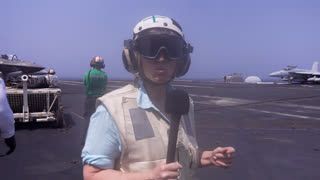
CNN anchor Pamela Brown “reported live from the USS Abraham Lincoln” this week, “becoming the first American journalist with such access,” as Mediaite noted here.
I have been surprised by the dearth of “embeds” during the war with Iran, so I asked Brown to share the backstory behind her gripping live shots and reports from the aircraft carrier.
“Back in early spring, not long after the war started, I reached out to a Pentagon contact and asked” about the possibility, Brown said while on the way home yesterday.
“I was pretty persistent checking in to see where things stood and just stayed patient,” she said.
Last week, the CENTCOM public affairs office called with good but challenging news — Brown and her crew needed to get to a port on the Arabian Sea.
“It was a huge logistical challenge to get the approvals in time,” she said, “but I got everything I needed the day I boarded the flight to Oman Sunday. From there I took another flight and rushed to board the ship since they moved up its departure a day early given the escalating tensions.”
It wound up being a different trip than the CNN team expected, she said, given the renewed US strikes in Iran this week.
“The crew members and ship leadership were very welcoming and gave us unique and rare access to operations and behind-the-scenes of life on the ship,” she said. “I talked to an array of crew members from 19- and 20-year-old enlisted sailors to the top leadership.”
Brown has a lot more to share from the trip, and her reporting will roll out on CNN newscasts in the coming days…
This edition of Reliable Sources was edited by Andrew Kirell and Robert Ilich, and produced with Liam Reilly. Email us your feedback and tips here.
ADVERTISEMENT
You are receiving this newsletter because you signed up for Reliable Sources.