Hey! This weekend is crammed with news, so we're delivering you a special Saturday edition of Reliable Sources, chock full of the best #longreads of the week. First, the latest news...
|
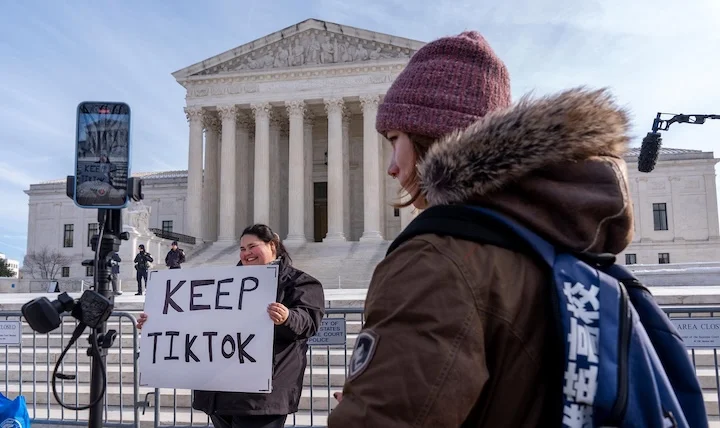
TikTok is trying to afflict maximum pressure on the U.S. government right now.
That's the best way to interpret last night's statement that TikTok could be "forced to go dark" on Sunday, one day before President-elect Donald Trump's inauguration.
The Biden administration signaled that it won't enforce the bipartisan law signed by Biden on his final day in power, saying "actions to implement the law simply must fall to the next administration." But some service providers — companies like Google and Apple that would face exorbitant fines for allowing access to TikTok once the ban takes effect — told TikTok on Friday that they still believe they are vulnerable, according to a person familiar with the matter. The service providers "do not feel that they've been given enough assurance that they will not be liable," the person said.
Apparently that's what prompted TikTok's public warning. The company wants Biden to rule out any "enforcement" of the law. That's the key word. But the administration says its Friday morning statement was sufficiently clear, a White House official told me.
|
Maybe the app will disappear... for one day? |
So far, there have been no new developments this morning. For the moment, content creators and service providers are stuck in limbo between two administrations. Some Biden officials are content to let the ban take effect Sunday, even if that means TikTok turns off its lights, since the law was passed with strong support from both parties. They believe Trump is going to roll over to TikTok, national security concerns be damned. So maybe TikTok will go dark... until Trump signs an executive order on Monday.
This standoff feels like a new-media version of the carriage fee fights that sometimes break out between TV programmers and distributors. In the end, programmers with the hottest, most popular shows usually prevail. And what's hotter than TikTok right now? Its lobbying effort has worked wonders. Its users are stressed out about the impending ban.
|
I liked David Leonhardt's take in his NYT newsletter this morning: "It has become a cliché to lament that the U.S. government no longer does big, audacious things. But shutting down TikTok" would "certainly qualify as big and audacious."
Speaking of Davids at the NYT, columnist David French says the impending ban "is a virtual national security I.Q. test," asking, "Why would a rational nation give its most dangerous foe such comprehensive access to American data?" He says "Americans are slowly waking up to the reality that we’re in a cold war with China."
But I'd argue that politicians and experts who believe TikTok is a threat – and is actively hurting America – are mostly missing from the public conversation right now. Their voices certainly aren't showing up in users' TikTok feeds! The discourse is largely about when and how Trump will "save" the app – which is both a pro-Trump and pro-TikTok narrative.
Ultimately, TikTok is "a Rorschach blot that reflects back the prevailing concerns of its time and place," Caitlin Dewey writes on her Substack, Links I Would Gchat You If We Were Friends. "If you're looking for something on TikTok, in sum: You're abundantly likely to find it. And that makes the app a convenient vehicle for all kinds of social narratives. It’s good and it’s bad; it’s a threat and a solace; it’s revving up culture and tearing it down."
|
|
|
Jury finds CNN liable for defamation |
Hadas Gold writes: CNN settled a lawsuit Friday brought by a US Navy veteran over a 2021 segment on evacuations in Afghanistan, hours after a jury found the network liable for defaming him. A jury in Bay County, Florida, awarded Zachary Young $5 million in compensatory damages. Following the verdict, the two parties settled the case as the punitive damages phase was underway. The details of the settlement were not made public. "We remain proud of our journalists and are 100% committed to strong, fearless and fair-minded reporting at CNN, though we will of course take what useful lessons we can from this case," a CNN spokesperson said.
|
|
|
Journalists 'boarding up their houses' |
That's one of the striking quotes in David Enrich and Katie Robertson's NYT story about media outlets "taking unusual steps" to prepare for Trump's return to power. Among the actions: Some reporters and editors "are increasing their reliance on encrypted communications to help shield themselves and their sources from potential federal leak investigations and subpoenas," and outlets "are evaluating whether they have enough insurance coverage to absorb a potential wave of libel and other litigation from officials who have already shown an inclination to file such suits." Read on...
|
On the left, columnists are warning that media outlets are kowtowing to the incoming president. Mother Jones says, "Trump's return is pushing the media to self-censor." The Nation says, "the media is giving away its rights even before Trump tries to take them."
On the right, conservative media critics are predicting that the media will treat Trump unfairly, no matter what. "Trump could solve homelessness and the press would whine about social worker job losses," Dan Gainor writes in a FoxNews.com opinion piece. "Look for lots of evil tech CEO stories now," he adds, and "sympathy for illegal immigrants."
|
Five key reads about politics + media |
>> Trump's inauguration is set to trigger a period "of unprecedented uncertainty for press freedom," Reporters Without Borders says. (RSF)
>> Biden's inner circle "recognized his physical frailty to a greater degree than they have publicly acknowledged," and then they worked together to "manage his decline," Katie Rogers, Adam Entous, Maggie Haberman and Carl Hulse report. Among the many telling lines: "They chastised White House correspondents for coverage of the president’s age..." (NYT)
>> Biden White House comms director Ben LaBolt gave an exit interview to Lynn Sweet about the "increasing challenge of these jobs..." (Chicago Sun Times)
>> "Americans are checking out of mainstream and left-wing media as Trump takes office," Lucia Moses writes. (Business Insider)
>> New from Laurie Kellman and David Bauder: "Voice of America is required by law to report the news accurately. Could Donald Trump change that?" (AP)
|
|
|
'How Dana White's UFC conquered America' |
Tonight is another UFC Fight Night, so Jack Crosbie's Rolling Stone story "Empire of Blood" is a timely read. Exploring "how Dana White's UFC conquered America," Crosbie opens by describing Trump's attendance at a (brutally violent) UFC fight last November and says, "White runs the UFC the same way Trump runs America: top-down, tight control, with a warm hand toward those who are loyal and a vicious streak toward naysayers and challengers to his authority."
There's a lot to learn here. Crosbie also reports that "White got the Nelk Boys on Trump's plane, put him on the radar of podcaster Theo Von, comedian Andrew Schulz, and eventually" Joe Rogan...
|
|
|
Seven fantastic weekend reads |
>> Casey Newton scrutinizes Meta's MAGA makeover and says the company is "naively trading one impossible-to-satisfy constituency for another, and un-learning a decade of hard-won lessons about keeping people safe in the process." (Platformer)
>> "There's a reason why it feels like the internet has gone bad," and it's called "enshittification," Allison Morrow writes. (CNN)
>> "We need a Freedom of Information Act for Big Tech," Laura Manley argues. (Wash Post)
>> Angela Fu's latest about the Sun and the Banner: "A rare newspaper war was brewing in Baltimore. Then a billionaire owner began meddling." (Poynter)
>> "MSNBC's Project 2025:" Alex Weprin navigates how the progressive TV network will rebuild itself in the Trump era. (THR)
>> Whether you love him or love to hate him, the "cool under pressure" CNN commentator Scott Jennings "does it all with a smile on his face," Robert McGreevy writes. (Daily Caller)
>> Seth Abramovitch explores how Ben Shapiro rose to the top of the MAGA movement. (THR)
|
|
|
>> "To watch the destruction in Los Angeles through the prism of our fractured social-media ecosystem is to feel acutely disoriented," Charlie Warzel writes in a column titled "Beyond Doomscrolling." (The Atlantic)
>> John Herrman – always a must-read – says "social media is for consuming disasters, not surviving them." (NYMag)
>> Antonia Blyth highlights how local, LA-based reporters are fighting for accountability while reporting on the wildfires in their backyards. (Deadline)
|
|
|
Have you heard about 'The Stringer' yet? |
If not, this story by The AP's David Bauder is a must-read. "The Stringer" is a film that's "scheduled to debut next week at the Sundance Film Festival." Though shrouded in mystery, the film calls into question the photographer behind "one of the 20th century's most memorable images: a naked girl, screaming, running from a napalm bombing during the Vietnam War."
Photographer Nick Ut, now retired from The AP, "insists it was his," and Ut's lawyer "is seeking to block the premiere, threatening a defamation lawsuit." It's unclear exactly what the film will allege. But with knowledge that the film was in the works, The AP conducted a six-month review and concluded it "has no reason to believe anyone other than Ut took the photo." Here's the investigation, as well as Bauder's separate story explaining the situation...
|
|
|
Seven more superb weekend reads |
>> "Red Between The Lines:" There are "no official censorship laws in Russia—but that doesn’t stop writers from being ostracized, fined, or arrested," Katya V. writes. (Air Mail)
>> Charlotte Klein writes about NYC's
Century Club, the spotlight-shy, members-only club that has become "the media elites' private club of choice." (NYMag)
>> Horror writer Grady Hendrix's "most outlandish character is himself," Travis M. Andrews writes in this engrossing story about an author-and-showman who creates full-blown stage shows to accompany his books. (Wash Post)
> "The Business of History Is Booming:" Will Dunn says "books and podcasts about the past are surging in popularity, making them increasingly profitable." (Bloomberg)
>> Spike Jonze's tech drama "Her," released in 2013 and set in 2025, "imagined a budding romance between a man and his virtual assistant." So what did it get right about love – and the future? Here is Gina Cherelus's assessment. (NYT)
>> Vanity Fair's February cover story is Anna Peele's look at "Prince Harry and Meghan Markle's big business ambitions," and it's full of revealing details about the couple's struggles with Spotify... (VF)
>> And last but certainly not least, Matthew Jacobs sat down with Hans Zimmer to discuss the composer's most unusual and underrated scores. Personally, we're huge fans of the "Interstellar" soundtrack. And this interview made me want to check out Zimmer's live tour! (Vulture)
|
|
|
|
® © 2025 Cable News Network. A Warner Bros. Discovery Company. All Rights Reserved.
1050 Techwood Drive NW, Atlanta, GA 30318 |
|
|
|
|
|
|
|