From day one, the big, audacious dream has always been to grow a radically new, decidedly delicious, and truly equitable spice trade, to push a broken system into an equal exchange, and to have a lot of fun doing it.
To that end, we work to incorporate equity in all our relationships with farmers. There are four ways we do this:
🌱 1. We provide advances on harvests. More than 50% of Indian farmers are trapped in a cycle of debt — a number that has grown nearly 60% in the last decade. Committed to the financial security of our partners, we provide them advances so they are able to pay for operational expenses without loans that drag them into cyclical, generational debt.
2. 💰 We pay our farm partners living wages so they can afford to grow naturally and regeneratively along with us. Both commodity and Fairtrade prices (which are 15% above the average commodity price) are not enough to sustainably support this kind of growth. In 2021, we paid our farm partners an average of 4x the commodity price and over 3x the Fairtrade price. This varies from farm to farm, which means that for some farms we pay 2x, and for some we pay as much as 10x! Check out our 2021 Impact Report for more details.
3. 🌾 We add value on the farm. When possible, we prioritize creating the capacity for on-farm processing, as this adds value and allows us to pay farmers higher prices. For example, we helped the Narne brothers, who grow our Guntur Sannam chillies, to purchase a mill since, since on average, we are able to pay up to 25% more for powdered chillies versus whole ones. We are working to deepen this work with our Farm Worker Fund which launched in fall 2022, and will be piloted on our first three farms: the Parameswaran family farm, the Chacko farm, and the Narne family farm.
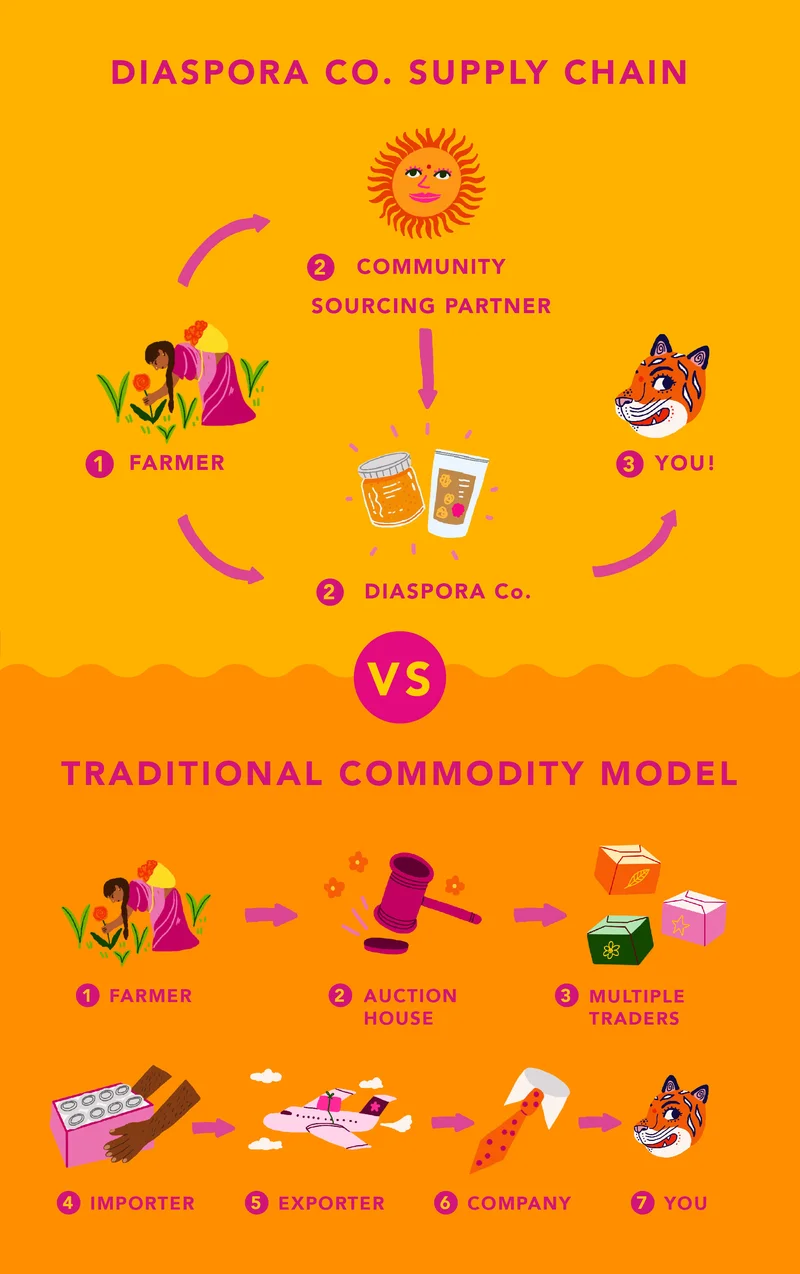
4. 👩🏽🌾 We build direct relationships with our farm partners, rather than going through middlemen, which allows us to pay farmers more, and work with them to improve processes as needed. The beauty of this single-origin supply chain is that we are able to invest in delicious heirloom spices that farmers have been growing for generations, but did not previously have a market for, and in regenerative farms that are working on soil health.
The commodity trading model that has existed for hundreds of years prioritizes quantity and profit over quality, equity, or sustainability. We’re here to say that that system is no longer good enough—we all deserve better.
|