Like a fine wine, points can elevate any trip, turning a long-haul flight into a lie-flat moment or a standard stay into something, well, suite-r. But unlike fine wine, points don’t get better with age. Points devalue quietly—and apparently quickly. Award charts shift. Programs change the rules mid-game. The longer you wait, the more value you’re losing.
2026 is the year to use your points, not save them for “someday.” Here’s what points-savvy travelers need to know right now.
|
|
|
|

Your next card offer is waiting
Get pre-qualified and limited-time card offers personalized to you.
|
|
|
|
|
The value of points is decreasing |
Points don’t age well because loyalty programs keep changing the rules. And lately, those changes have tended to make your points less valuable, not more.
Case in point, in 2025, Air France–KLM’s Flying Blue, Singapore Airlines’ KrisFlyer, and British Airways’ Avios raised award prices by 5–20% depending on the route and cabin. In some cases, additional cash surcharges on bookings increased as well.
This is the new pattern:
|
- More miles required for the same routes you used to book
- Dynamic award pricing that surges when demand does
- “Saver”-level award seats that are harder to find
- Hotels using seasonality and market data to nudge award costs upward
|
Whereas loyalty programs may have once been relatively fixed, they now move more fluidly with the market.
What does this mean? The value of your points today is almost always higher than the value of your points six months from now. Waiting for the “perfect redemption” is no longer strategic—it’s risky. The longer you sit on your points, the more likely you’ll wake up to another quiet devaluation.
|
|
|
Business class to Asia and Oceania is one of the best redemptions in 2026 |
Not because it’s flashy, but because the value per point is currently strongest on long-haul routes to Asia. Why? |
- A dense network of airline partners means more opportunities
- Award space is returning as routes expand
- Cash prices remain relatively high, widening the value gap
|
Economy flights to Australia and New Zealand are also seeing standout value windows, especially when booked with flexible partner programs.
Roundtrip points deals we’ve sent to Asia and Oceania for 2026 travel include:
|
- 37k–74k points to Seoul in economy from January–December 2026
- 49k–58k points to Tahiti in economy from January–September 2026
- 50k points to New Zealand in economy from January–March 2026
-
122k–146k to Taipei in business class from January–September 2026
|
So if you have been saving points for a “someday” long-haul, this may just be your sign to set your sights on Asia or Oceania. |
Psst! Looks like you don’t have the Going app.
Download it now
and get hot points deals to Asia and Oceania delivered right to your phone.
|
|
|
|
|
|

30% off Going
Get the full Going experience at a discount through January 20!
|
|
|
|
|
The Goldilocks Window hits different for points |
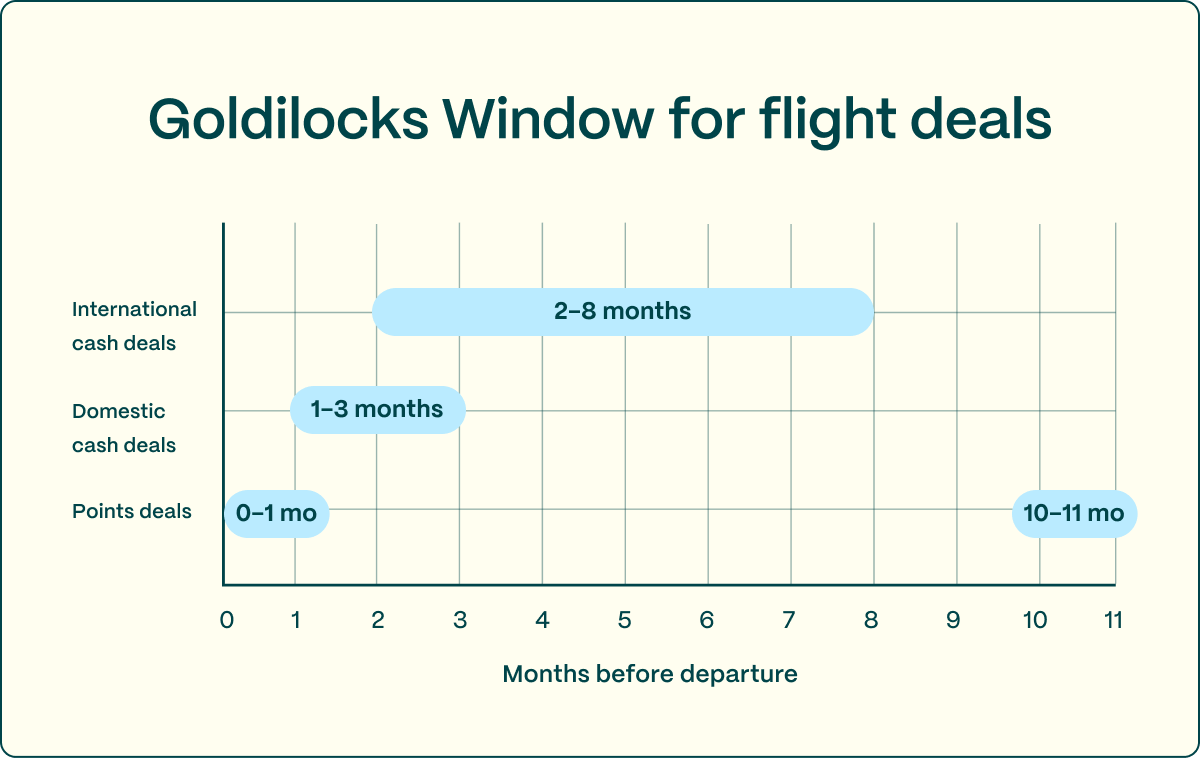
The “Goldilocks Window”: not too early, not too late, right in that sweet spot when you’re most likely to find a great fare. If you’re paying with cash, the window is 1–3 months ahead of departure for domestic and 2–8 months ahead for international (add a couple months if you’re traveling during a peak season, like summer, winter holidays, or Carnival in Rio).
Award travel, however, plays by its own rules. The curve looks almost inverted compared to cash prices.
|
When you’re using points and miles, availability tends to peak at two different times: when airlines release their schedules (about 10–11 months out), and then again in the final weeks before departure. In between, the period when cash deals are often at their cheapest, can actually be the worst time to find good redemptions.
Here’s the gist of why this happens: When schedules first open, airlines often release a handful of saver-level award seats per flight, particularly in business class. As demand takes shape, those cheaper award seats often disappear. Then, as departure approaches and airlines reconcile how many seats are likely to go unsold, they quietly release another wave of award seats.
Counterintuitive? Maybe. But pretty consistently that’s what happens: Award space often dries up during the months when cash fares are typically cheapest.
So if you’re trying to travel on points, it’s time to rethink the usual playbook. The Goldilocks Window for cash fares might still be golden, but for award travel, the sweetest spot can be much earlier or much later. Want the best shot at premium cabins, long-haul routes, or ultra-popular destinations? Look right when the schedule opens. Missed that window? Check again when your trip is getting close—much closer than you’d assume.
Cash has a Goldilocks Window. Points have bookends. Knowing the difference can be the key to unlocking the award seat everyone else swears doesn’t exist.
|
|
|
NEW: Should you book with points or cash? |
It’s a common question, and one that doesn’t always come with a clear-cut answer. Luckily, we released a new calculator that helps you decide. |
-
Found a points deal on your own, and wondering if it’s worth the transfer? The calculator will tell you yes or no.
- Know the cost of a flight in both points and cash, and deciding which is more cost-effective? The calculator will tell you which to book with.
|
The calculator is built on Going’s internal flight metrics. And the point is to help you maximize your points, while also making sure you don’t pass up a good cash deal in the process. It’s not fancy, but it can help you keep more cash in your pocket and points in your program—loyalty program, that is.
Use the calculator.
|
|
|
|