It’s science: Planning your trips well ahead of time is better. Not waiting until the last minute gives you time to wait in joyful anticipation for your trip. It ensures that you have time to find an amazing deal that’ll get you there, especially for those far-flung destinations. And it reduces the chance that your chosen tour will be sold out.
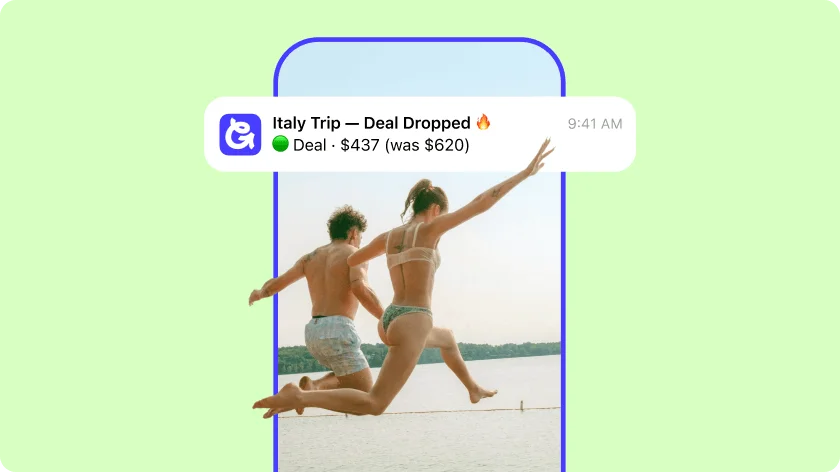
If you have one of the following trips on your mind for 2026 (or 2027, or even 2028), we recommend you start planning now. And when it comes to the flights that get you there, make sure you have the Going app downloaded, flight alerts set up, and push notifications turned on so you know when the best deals drop.
|
|
|
|

Your next card offer is waiting
Get pre-qualified and limited-time card offers personalized to you.
|
|
|
|
|
1. Intimate tours with limited space or trips likely to sell out |
Some excursions are designed to be shared with few people. It allows for less wear on fragile spaces and enables you to get much closer to your subject in small vessels or vehicles. By nature, their diminutive size makes them a scarce commodity. |
Some gorilla trekking tours, like in Rwanda, generally allow only eight visitors per trek. Such small groups enable the gorillas to relax and just about forget you’re there; put less stress on delicate mountain and lowland flora; and lower the risk of passing along human diseases to the primates, with whom we share 98% of our DNA. |
Both Nile dahabiya tours and Kerala backwater journeys on a kettuvallam (South Indian houseboats) offer amazing, often-remote scenery at a leisurely pace. Intimate vessels like these have few beds per sailing, so planning is necessary if you want to explore the uninhabited islands near Egypt’s Aswan or the palm-fringed canals and lagoons of India’s Alappuzha region.
|
Outfitted dry-season African safaris |
During Southern and East Africa’s dry seasons, wildlife-viewing conditions are in their prime, with minimal mud, cooler temperatures, and low grass cover. The dry season in Botswana’s Okavango Delta and South Africa’s Kruger lasts May through October, while Tanzania’s Serengeti and Ngorongoro Crater run July through September. The most sought-after safari camps operate within protected wildlife preserves, offering small-plane transport, well-trained guides, and a limited number of beds, so plan accordingly.
|
How far in advance you should plan these |
To ensure your spot on these limited-space adventures, be prepared to book nine months to one year ahead, if not more. Flights should be booked 1–3 months ahead for domestic travel and 2–8 months ahead for international travel, plus a couple extra months if you’re traveling during a peak season. |
|
|
2. US trips that include a lottery or application to attend |
Some special places in the US inspire so much interest that controlling their visitor flow becomes vital to their existence. Enter the need for lotteries and applications, many of which are handled by Recreation.gov. Sign up for a free account on the site, and get to entering, applying, and hoping for the best. |
Hikes in state and national parks |
The roughly 15-mile, 4,200-foot trip to the summit of Yosemite’s epic Half Dome requires permits for day hikers seven days a week when its assistance cables are up (normally the Friday before Memorial Day through the second Tuesday in October). Only 225 day hikers are allowed each day, and the preseason lottery runs from March 1–31 (East Coast time).
You’ll also need a permit to hike Kauai’s 22-mile Kalalau Trail, which begins in Hāʻena State Park and provides the only land access to the lush Nā Pali Coast. Hawaii only allows 60 people on the trail at a time, and permits let you camp (with aloha) for up to five days along this out-and-back journey. You’ll need to apply for yours through the state’s reservation system.
|
Undulating five roundtrip miles through Arizona’s Paria Canyon–Vermilion Cliffs Wilderness, the red-sandstone canyon known as The Wave requires a permit. Of the 64 daily permits allowed, 48 are posted to an online lottery each day, four months in advance of their visiting date. E.g., if you want to visit in June, enter in February.
Within another red-rock canyon in Arizona, the 50-foot Havasu Falls tumble from limestone cliffs into gleaming teal pools. The falls are on land administered by the Havasupai Tribe, who don’t allow visitors to day-hike the 10-mile one-way trail or book a commercial tour. Instead, you’ll need to secure a permit ahead of time to stay overnight in the onsite campground.
|
These are some of the US’s most sought-after stays, and competition in popular parks like Yellowstone, Glacier, and Acadia is fierce. E.g., 16-room Brooks Lodge is the only indoor lodging in Alaska’s Katmai National Park near the Brooks Falls bear viewing action during the salmon spawn, and it’s open from June 1 to mid-September. To enter the lottery, apply online from December 1–30 for stays two years out (e.g., apply in December 2026 for 2028 lodging).
On the floor of the Grand Canyon, Phantom Ranch’s nine updated 1920s cabins (each with two bunk beds) are made available only by lottery. Apply online 15 months in advance of your desired visit, and note that each applicant can only book up to four consecutive nights for up to ten guests. About 10 miles below the canyon rim, Phantom Ranch is reachable only by foot, mule ride, or river raft. The latter requires a river permit via another lottery.
|
How far in advance you should plan these |
Permits for most of these attractions require reservations four months to two years in advance. Book flights 1–3 months ahead for domestic travel and 2–8 months ahead for international, then add a couple months if you’re traveling during peak season. |
|
|
|
|
Unlock Premium for 30% off
Upgrade to track every trip, get international deals, set custom alerts, and access exclusive member perks. Only at Going.com.
|
|
|
|
|
3. Trips around a major event |
When an experience can only be had once a year—or even more rarely—it makes a lot of bucket lists. Because the dates for events like those listed below are publicized far in advance, only the most organized early birds will score the best flights, hotel locations, and more. |
A week-long celebration held each February, Rio de Janeiro’s Carnival includes the glitzy, feathery Sambadrome Parade, which unfurls in a multi-day, dusk-to-dawn reverie. Where you stay in relation to the festivities can make or break your experience, so don’t delay booking your ideal spot. While you’re at it, reserve tables at those restaurants you’d hate to miss. The same goes for things like Mardi Gras in New Orleans and similar events.
|
Olympic Games and other sporting events |
The granddaddy of sporting events plays out on a four year cycle, with alternating summer and winter Olympics held every two years. Cities and major competition venues are announced years in advance. As soon as the news goes public, the travel-booking clock starts ticking. LA is up next in 2028. But first: the 2026 World Cup, held in major cities throughout North America. |
Cherry blossom season in Kyoto, Tokyo, or DC |
Usually late March to early April, this petal-pink floral spectacle is one of the most popular attractions in both Japan and DC, with hotels anywhere near cherry trees booking up more than a year in advance. |
The sun, moon, and Earth line up for a solar eclipse twice a year, either total or annular (“ring of fire”). Eclipses don’t always occur near the US. When they do, they’re a hot ticket for US travelers. Campgrounds and high-rise hotels within the path of a future eclipse will have the best views, and reservations go fast. |
How far in advance you should plan these |
Aim to book your travel arrangements at least 18 months in advance. Flights should be booked 1–3 months ahead for domestic travel and 2–8 months ahead for international, plus a couple extra months if traveling during a peak season. |
|
|
4. Trips that are epically far and/or expensive |
Whether you’ll need to make winging ‘round the world worth your while or simply save up a small fortune, there are some once-in-a-lifetime adventures that require a healthy lead time to get all your ducks (or blue-footed boobies) in a row. Here are just a few. |
Launched year-round on ships that carry 10–100 passengers, guided sailing trips to the remote Galápagos Islands tend to last 7–16 nights and cost $5,000–$12,000 per person. You’ll also lose almost two days of travel time getting to and from your port on mainland Ecuador (Quito or Guayaquil). Book well in advance to get the outfitter, ship, and cabin of your choice, likely at a discount, and to accrue the PTO you’ll need to meet the wildlife you’ll only see here. |
The typical route to the Antarctic Peninsula: Fly to the southern tip of South America, then brave a 48-hour small-ship sail on the notoriously choppy Drake Passage. To explore Antarctica for five days, you’ll spend 9–11 days traveling. You could show up in the port city of Ushuaia, Argentina, and try for a last-minute boat, but only if PTO and hotel budget aren’t a hindrance. Just 50 small ships sail during Antarctica’s travel season (November–March), and guided journeys average $9,000 per person. Putting down a deposit early ensures you don’t exceed your budget or waste vacation time.
|
Some of the most sought-after rail journeys are also the most expensive, costing upwards of $1,000 a night. Bookings are limited aboard glamorous trains like Europe’s Venice Simplon-Orient-Express; The Ghan, which traverses Australia for 1,851 miles; and the Palace on Wheels, a seven-day trip across India, past the pink palaces of Rajasthan, tigers of Ranthambore, and Taj Mahal. For these trips, look down the tracks so you don’t miss the train. |
How far in advance you should plan these |
Plan to book expensive, far-flung guided itineraries, boats, and/or trains at least a year ahead. Not only will you be (more) sure of getting a good seat or cabin, but you’ll give yourself time to save up cash. |
|
|
5. Trips you need a lot of physical preparation for |
Adventures that require you to be in good shape are great ways to inspire a fitness plan—but a fitness plan takes time to yield results. And if you want to explore wild territory, you’ll likely need a roundup of shots. Give yourself plenty of headway for trips like these that are physically demanding or otherwise risky to your health. |
Dreaming of scaling a peak like Everest, Kilimanjaro, or Denali? You’ll need to secure necessary permits, research mountain conditions, gather the right gear, and train five days a week, both for strength and endurance. Before booking the trip, book an appointment with your doctor and/or a trainer to determine your fitness baseline. This will help you plan more accurately. |
Walking the Camino de Santiago or another long-distance walk |
You’ll want to check your fitness level before attempting a long walk like the 96-mile West Highland Way in Scotland, the 2,000-plus-mile Appalachian Trail, or the 500-mile Camino de Santiago in Spain/France. You’ll want to break in your boots, make reservations at hostels (unless you want to wing it), and request time off work far in advance. You can do shorter sections of any long-distance hike, but you’ll still want to walk, hike, and stretch before you go.
|
Vacations that require vaccines |
Before booking an international trip, check the Center for Disease Control’s list of destinations to see if you’ll need vaccines for anything from yellow fever to hepatitis and cholera. If you will, find a clinic, determine how many rounds of shots are required and how far in advance, then make sure you have the proper paperwork to present at airports. It pays to sort out these details before you decide on travel dates, much less purchase the most expensive portions of your trip.
|
How far in advance you should plan these |
As soon as the idea of one of these trips pops in your head, check in with a health professional and get a sense of how long you’ll need to get strong and/or vaccinated—then allow yourself at least six months before you travel. |
|
|
|