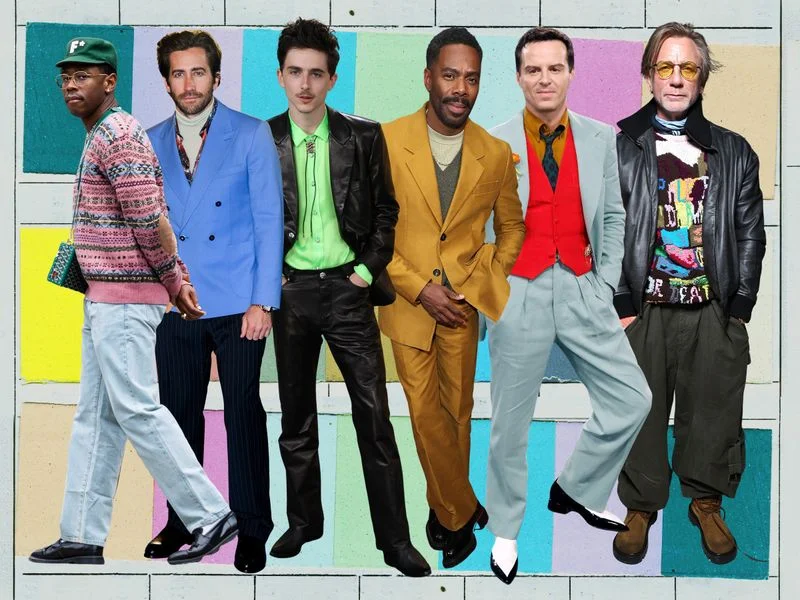
Color analysis has gone viral—again. If you spend any time on TikTok, you’ve probably watched someone discover they’re a Winter or Spring, and then swear off entire color palettes based on these findings. People don’t always look thrilled with their results either. But don’t go donating those burgundy cords just because you’re a Summer. This seasonal color theory, it turns out, is just one way—and maybe not even the best way—to figure out what hues best suit you.
According to Leatrice Eiseman, executive director of the Pantone Color Institute and one of the world’s leading color experts, these seasonal charts can help, but they’re not the holy grail. “I think what they do is enable you to feel more confident about your choices,” says Eiseman. “It simplifies the process of choosing clothes you feel good in.”
Finding your colors is personal. It’s part science, part emotion, and, ultimately, all about creating confidence. To discover more about how to wear color with intention, we spoke with a color neuroscientist, a celebrity stylist, a trend forecaster, a textile designer, and a style-savvy creative who lives and breathes color. Here’s what they told us.
Color is a language, so learn how to speak it
Color isn’t just about looking good—it’s about communicating.
“The ways in which we display colors and the color choices we make, those are a kind of language that we have learned,” says Bevil Conway, a neuroscientist, artist, and senior investigator at the National Institutes of Health. “They’re very much informed by who you're talking to, what you’re seeing, and what other people are wearing.”
In short, the colors we’re drawn to aren’t random. They’re shaped by what we see and who we spend time with. The same way we learn to talk, we also learn how to “speak” with color, and that’s often based on the people and culture around us.
You can think of color like style: it’s personal, but it’s also social. The colors you wear send a message, whether you mean to or not. Learning to “speak” with color means paying attention to what feels right for you and also knowing how it lands in the world around you. The same scarlet red knit vest might shout confidence at a party and project defiance in a boardroom.
Conway says there’s no universal rule about what colors make each individual feel energized or calm. Instead, he says to start by thinking about what color choices say when you’re entering a room.
Let secondary colors be your secret weapon
Secondary colors are a mix of two primary colors. That means purple (blue + red), orange (yellow + red) and green (yellow + blue). They add depth and are often more wearable and more unexpected than primary colors.
“I often work in that secondary color palette specifically because it speaks to my playfulness and my optimism about life,” says Lexson Millington, a fashion creator with 456,000 followers on TikTok. “It’s easy to express those feelings through secondary colors.”
These oranges, greens, and purples can be bold and saturated. But they don’t have to be. “I like that secondary colors don’t always have to be vibrant,” says Millington. “They can be lighter or darker tones.”
Muted secondary colors (olive green, dusky purple, rust orange) can be easier to wear day-to-day because they’re closer to a neutral. If you want to use a more saturated version, and you’re just starting off, try adding it with an accessory.
Click here for more crucial tips on pulling off color right.