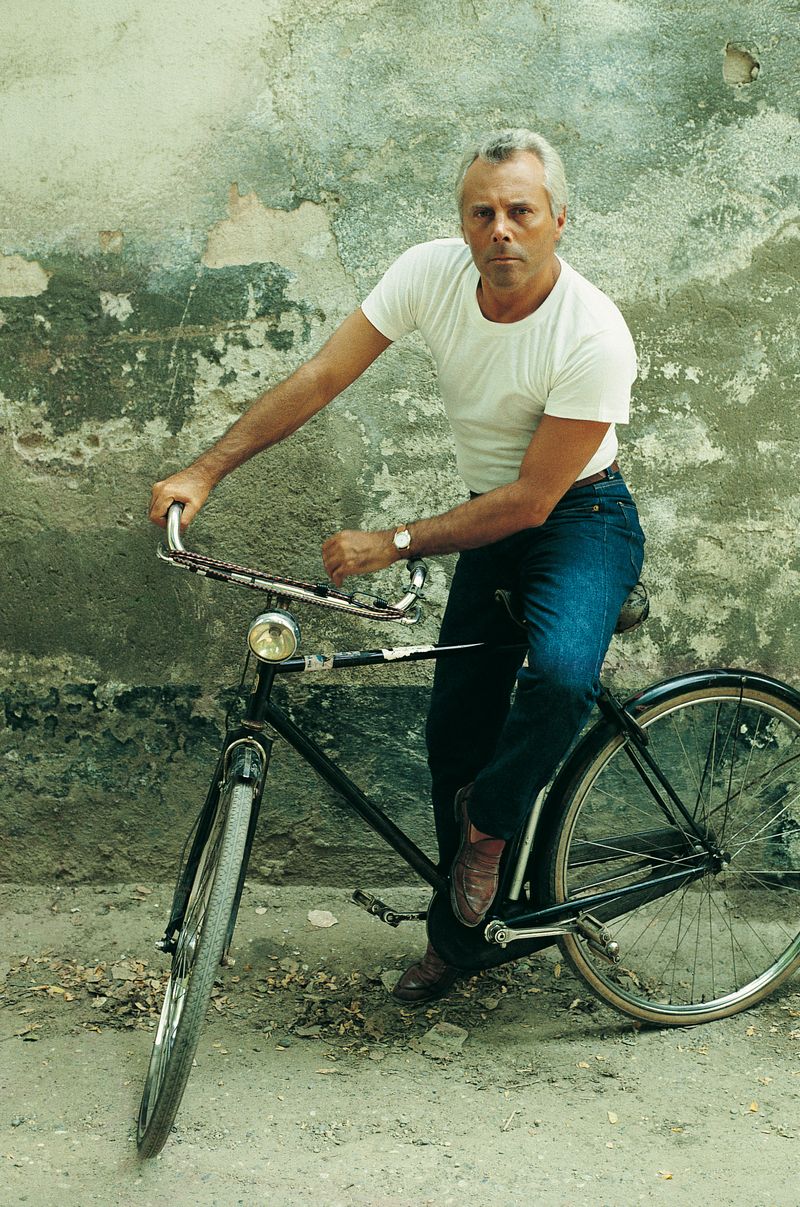
Giorgio Armani, 91, the godfather of Italian style and a defining force in menswear for half a century, died today in Milan. GQ’s global fashion correspondent Samuel Hine wrote a remembrance of Armani that contrasts his extraordinary legacy with his retiring personal life. Here’s an excerpt.
Armani’s passing represents a towering loss for fashion. The history of menswear in particular can be sorted into pre- and post-Armani eras. He had a knack for quietly but firmly reacting to the wider cultural and social mood, and in the ’80s he revolutionized the men’s suit by stripping the stiffness out of the boxy banker silhouette, dispensing with shoulder pads and cutting the trousers with a louche fullness. The Armani look was dressy and elegant but disarming; his tailoring didn’t project power but rather spoke to an inner sophistication. He cut clothes that were alive on the body, and as the ’80s turned into the ’90s his sense of style seemed to capture the optimistic spirit of a modernizing time.
For most of the 50 years he spent at the helm of his company, Mr. Armani was one of fashion’s most consistent and influential voices. Though the designer was personally shy, his work became a fixture of Hollywood. A cinema buff, Armani dressed Richard Gere in 1980’s American Gigolo, which turned his timeless Italian tailoring into a State-side sensation. He would go on to costume hundreds more films over the decades, thanks in part to a longstanding friendship with Martin Scorcese, whose 1990 documentary Made In Milan follows Armani as he prepares for a fashion show. He was also early to spot the rising importance of the red carpet. At the 1990 Oscars, before the rise of the celebrity stylist, he dressed the likes of Jodie Foster and Julia Roberts, among others. WWD called it the “Armani Awards,” and the red carpet arms race was officially on.
Armani himself was ambivalent to the rise of fashion in pop culture and designer as celebrity. He shied away from the limelight, preferring to spend his evenings working in his palatial design studio to attending galas or indulging in the Milan nightlife. He said that he experienced his own global fame with a kind of detachment, and throughout his career he kept a tight inner circle of friends and family rather than the sprawling retinue of some of his socialite-designer contemporaries. He never had children, but in 2015 the designer told GQ that he wished he had become a father.
Read the full remembrance of Armani.