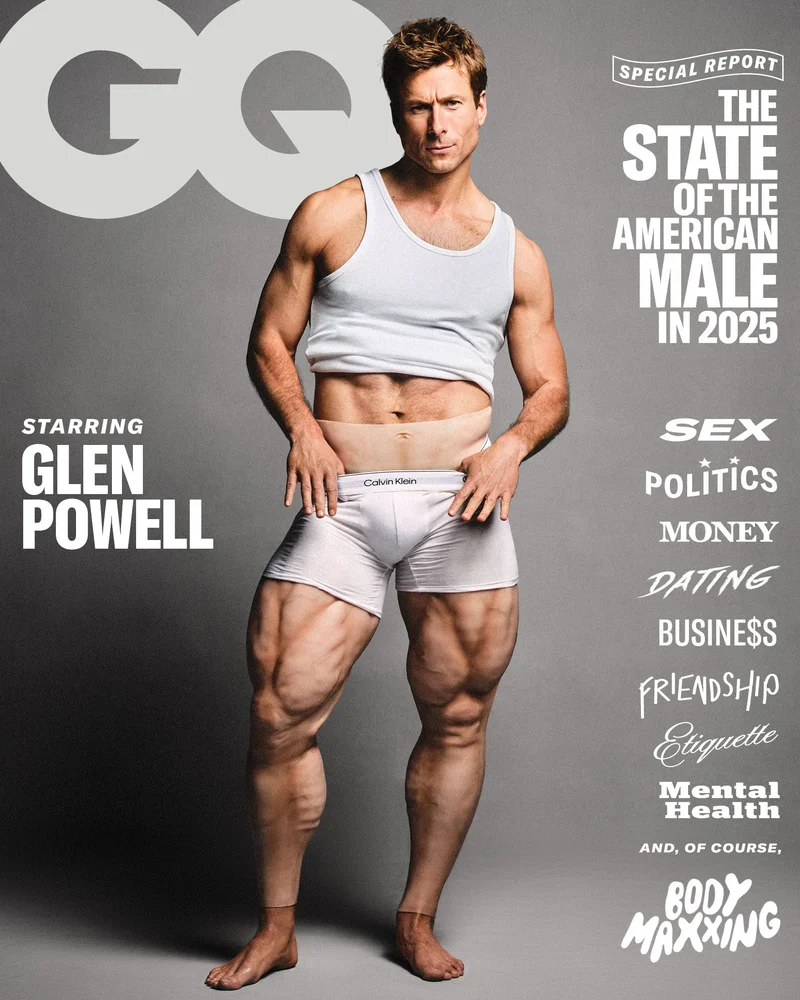
When Glen Powell was in his 20s, he wrote Sylvester Stallone a letter. At the time, Powell was still trying to succeed in Hollywood and, as he recently described it to me, at “the point of famine.” Stallone was casting the third installment of his aging-action-hero franchise, The Expendables 3. Powell, an unknown desperate to join the ranks of a call sheet full of over-the-hill action stars, recounted for Stallone the way he was raised. In Texas, Powell said in his letter, he grew up with a gun range in his basement, had learned to fight from his uncles, and had spent long stretches of his childhood trying to find new ways to cheat death.
Improbably, the letter worked; Powell got the part. Even more improbably, nearly everything Powell wrote was true. “I mean, I wouldn’t say I was trying to cheat death constantly,” Powell said. But he did grow up “with a gun in my hand”; there was a range at the family’s ranch. Powell and his cousins would put on plays at the theater there—“The first play they had, they decided to do James Bond,” Powell’s mother, Cyndy, told me. “But there had to be seven James Bonds.” Powell would spend each summer learning how to do something new. “Whether it’s changing a tire or operating a tractor or breaking a horse,” Powell said. “They were big on skills in my family.”
Powell has since turned this kind of old-fashioned masculine competency into a career as a leading man. This fall, he is the star of both Chad Powers, a comedy series on Hulu, in which he plays a disgraced quarterback, and The Running Man, a big-studio action film from director Edgar Wright based on the 1982 novel from Stephen King. Where these two otherwise very different projects meet is where Powell excels: Both require a comfort in the character’s body, a natural athleticism that is often faked in Hollywood but is noticeable when real.