When the indie distributor Neon recently won their second Best Picture Oscar with Anora, it also marked the fifth anniversary of their first win: for Bong Joon-ho’s Parasite, a South Korean thriller about a lower-class family that cons their way into a wealthy family’s life. Now Bong’s follow-up film is finally in theaters, where it is poised to both become his highest-grossing movie in the U.S. and lose a bunch of money for Warner Bros., who for the past year has appeared ambivalent bordering on reluctant about actually releasing it. In this big-studio limbo and in the contents of the film itself, Mickey 17, starring Robert Pattinson as an “expendable” worker subject to seemingly endless on-the-job deaths and corporate-funded rebirths, is Bong’s most American film yet.
Parasite fans may be surprised to discover a baggier, less gracefully zig-zagged thriller in Mickey 17. The film begins with Mickey (Pattinson) already doing grunt work for a group of colonizers on a distant planet; he explains in wobbly-voiced, schnooky tones that he and his partner in petty crime (Steven Yeun) sought to escape some murderous gangsters by slipping the surly bonds of Earth and entering the equally surly bonds of, essentially, indentured servitude. Having signed a contract without reading it carefully, Mickey’s an expendable, performing tasks that often turn out to be worse than they look. (When he’s sent out on a spacewalk to make some minor repairs, his bosses are actually testing the effects of radiation exposure.) Once they kill him, his body is disposed of, and he is “reprinted” into a new body, his full memories intact.
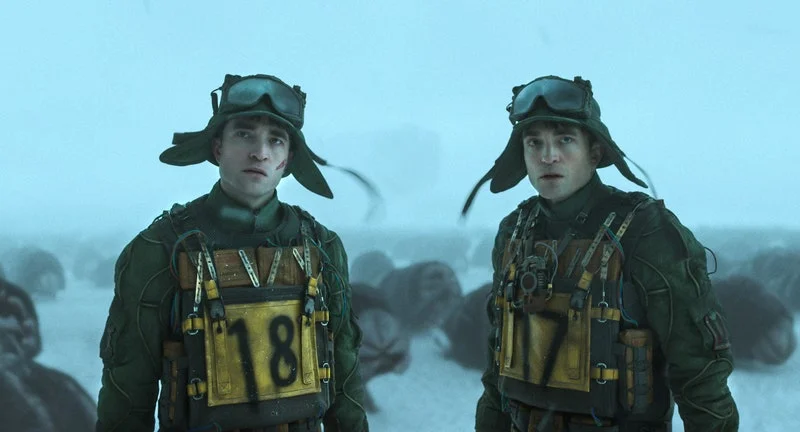
This apparent scientific miracle is hilariously undercut almost every time the human-maker expels a new Mickey and stutters like an office copier struggling through a paper jam. Greater complications arise when the seventeenth Mickey, fully expected to meet his doom via a swarm of bug-like “creepers” out on the frozen plains, doesn’t actually die. His bosses unknowingly print an eighteenth Mickey before the seventeenth makes it back to base. “Multiples” being strictly forbidden, the Mickeys are initially pitted against each other, rather than their cruel overlords.
This all sounds far more straightforward than it plays, which is both the buzzy strength and part-time frustration with Mickey 17. The hook of a worker who lives to be repeatedly murdered by his job is a sharp, potent one, and makes the movie sound like an ideal companion to Parasite. In reality, it’s more like Okja, Bong’s movie about a young girl fighting to save a genetically modified “super-pig” from the American meat industry. Both films ramble away from their central conceit just as we’re getting excited by their possibilities, rather than uncoiling with Parasite’s spinning-plate virtuosity.
Scene to scene, the new movie is inventive, entertaining, and engagingly acted by Pattinson and Ackie. As a holistic experience, it's more than a little disorienting; the film has a lot more explaining to do before it even gets started, and jumps around frantically as a bunch of different characters try to kill each other. This is probably appropriate for a film that engages more directly with American culture than Bong’s previous work; the fact that Mickey 17 doesn’t have time to flesh out all of its relationships (even at a longer-than-usual 137 minutes) because it’s too busy working is probably part of the point. —Jesse Hassenger