|
|
THE OBJECTIVE
|
|
SIDEWAYS IS THE NEW UP
|
|
|
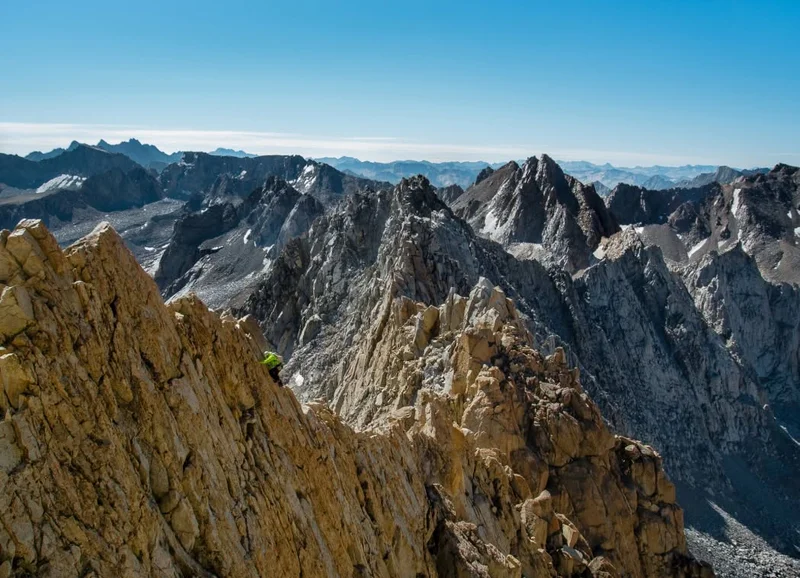
Matt Van Biene surfs the great granite wave of the Evolution Traverse. High Sierra, California. Photo: Austin Siadak
|
When I was younger, I chased purity. I wanted the most direct, aesthetic line to the top. These days, I see it differently. I’ve realized that reimagining the rules hasn’t changed the experience. Instead, I’ve been able to continue finding inspiration and psych that match where I am in life. And I’ve found that the “best” line isn’t always the most direct one. It’s the one that gives you the experience you need at that moment. To find these lines, I stopped looking up, and started looking sideways.
This notion has been on my mind since I returned from a traverse just a few hours from home. The experience packed in everything I’m currently looking for, and I’m still filled up from it weeks later.
The idea to link all 13 of the 14,000-foot peaks in the Sierra Nevada in a single winter push came from professional skier and YouTuber Cody Townsend. Runners who’ve done it in summer dubbed it “Norman’s 13.” The route covers roughly 85 to 90 miles, with around 40,000 to 50,000 feet of vert. It’s a massive undertaking in summer; in winter, it’s a different beast entirely.
Cody, Bjarne Salén and I spent the first three days climbing and skiing the biggest peaks in the southern range. From there, we traveled 50 miles north, skiing, bushwhacking, making challenging river crossings, and hiking in ski boots through dirt toward the steeper Palisades. We ended the trip by completing the Palisade Traverse and slogging down to the car we’d stashed in Big Pine. The trip took eight days total, but it felt like a year’s worth of adventure.
We skied a dozen 3,000-foot couloirs, followed bear tracks through a sequoia forest at 3 a.m. and took a “bath” by jumping through a hole in the ice. We saw some of the most spectacular sunrises and sunsets I’ve witnessed in North America. There were broken pieces of gear. At least one grown man cried. And somewhere along the way, I fell in love with the Sierra all over again. What struck me most was that, despite being within a day’s drive of more than 20 million people, we saw exactly one other person who wasn’t part of our team.
|
|
The Case for Going Sideways
|
Traverses are a novel way to get creative in landscapes that have become familiar. They open up new possibilities without needing to fly to the ends of the earth. Let’s be honest, Himalayan expeditions are resource-intensive, expensive and involved. I’d argue that linkups and traverses close to home can provide just as much depth and satisfaction. And often, the climbing is better!
Sideways climbing can also be a way of “greenpointing.” Ride your bike to the trailhead. Take public transportation. Strip things down. Make the approach part of the experience. For decades, climbers have said the great mountains have all been climbed, and maybe that’s mostly true. But for those willing to get creative and make up their own rules, the opportunities for exploration are nearly limitless.
|
|
A Few Inspiring Traverses
|
If you need a place to start, here are some traverses that come to mind. I’ve limited it to routes I know, on mountains that involve at least some fifth-class climbing. Some of these objectives blur the line between a traverse and a full-on endurance test. In my mind, the more contrived, the better.
This list barely scratches the surface. If you know of a great traverse we left out, send it in.
|
|
|
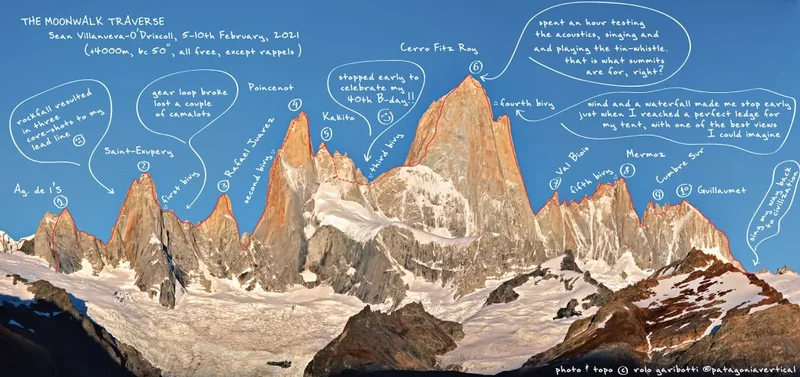
The legendary Rolo Garibotti’s topo of Seán Villanueva O’Driscoll’s equally legendary Moonwalk Traverse in Patagonia. Photo: Rolo Garibotti
|

|
|
Fitz Traverse, Argentinian Patagonia. Links the seven summits of the Chaltén Massif. First completed by Alex Honnold and myself over five days. This one is still one of the most impactful climbing experiences of my life. Seán Villanueva O’Driscoll later soloed it in reverse, calling it the
“Moonwalk Traverse.”
|
|
|
|
Torre Traverse, Argentinian Patagonia. Shorter than the Fitz Traverse, but steeper and more technically demanding. One of the most striking skylines in the world.
|
|
|
|
The “Double M” Traverse, Torres del Paine, Chile. A wild, complex line through one of the most dramatic mountain groups on earth.
|
|
|
|
The Cirque Traverse, Wind River Range, Wyoming. A fun challenge to do in a day if you’re feeling spunky.
|
|
|
|
The Grand Traverse, Teton Range, Wyoming. This one’s pretty classic, first completed in 1963 by a bunch of Yosemite climbers in under 24 hours (20 hours 30 minutes), which is pretty impressive even nowadays!
|
|
|
|
Norman’s 13 (Winter), Sierra Nevada, California. A winter enchainment of the 13 California 14ers. Big, remote and surprisingly complex. Even in summer, this is a grand adventure that covers almost 100 miles of terrain.
|
|
|
|
Evolution Traverse, Sierra Nevada, California. Eight miles of ridgeline? What a treat.
|
|
|
|
Palisade Traverse, Sierra Nevada, California. These summits are high and technical.
|
|
|
|
Goliath Traverse, Sierra Nevada, California. A modern testpiece—visionary, demanding and still evolving as climbers continue to explore its potential.
|
|
|
|
CDUL, Rocky Mountain National Park, Colorado. The acronym was inspired by a running traverse in Utah called the WURL (Wasatch Ultimate Ridge Linkup). The CDUL (Continental Divide Ultimate Linkup) covers over 70 pitches and 36 miles, and was climbed in a continuous 36-hour push. This route was dreamed up by Adam Stack during COVID and later climbed by Alex Honnold and myself, with Adam generously supporting.
|
|
|
|
HURT Red Rock, Nevada. The “Honnold Ultimate Red Rock Traverse.” Incredibly complex and massive. Likely to go unrepeated for a long time.
|
|
|