|
|
|
|
Your monthly newsletter for better thinking |
|
|
|
|
|
|
 |
Most of us are taught to plan first, and then to act. Gather all the information, think out every possible step. And wait until you're ready.
But what if the opposite was true?
Take scientists. They start with curiosity. They run tiny experiments to reveal the next step of the plan. They learn faster and waste less effort than those who “plan” everything in advance.
Now, you can learn to think the same way. We've partnered with neuroscientist Dr. Anne-Laure Le Cunff on an exclusive workbook. With a short read and 8 practical exercises, challenge assumptions and build confidence, one experiment at a time. |
|
|
Rather not receive these monthly insights? Unsubscribe. |
|
|
What's inside? |
Workbook: overthinking → experimenting Your brain on uncertainty How to pick the right experiment Norway's first astronaut - from paralysis to space |
|
|
|
|
|
 |
|
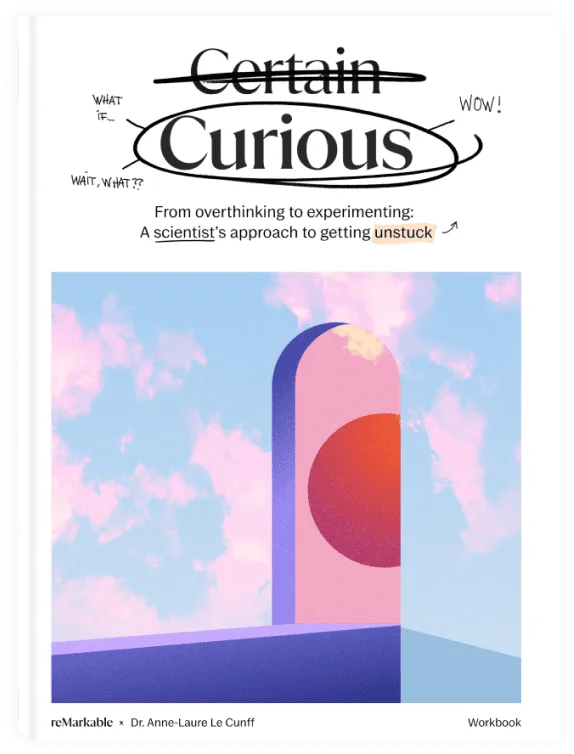 |
| Many believe in the perfect plan. But few realize it's an illusion. This brief workbook reveals why and gives you full permission to follow curiosity over certainty.
You'll see how the terrain ahead emerges through tiny experiments. After practicing thinking like a scientist, you might even realize that thriving in uncertainty is not about knowing the answer, but about running the right tests.
Download your workbook (PDF) |
|
|
|
 |
Before starting the workbook, consider watching Dr. Anne-Laure Le Cunff's talk on experimentation. This exclusive video from reMarkable Campus sets a solid foundation.
Watch the talk (17 min) |
| We highly recommend her book Tiny Experiments
. And for weekly insights, 120,000 peers read her newsletter with neuroscience-backed strategies for mindful productivity. Try her newsletter. |
|
|
|
|
|
|
 |
|
You look up and see something you can't quite identify. Is it a balloon? A plane? Columbia neuroscientists found that your brain lights up to figure it out—and the less certain you are, the more curious you become.
So if our brains get curious when facing the unknown, why do most of us still reach for the familiar? Why choose the predictable path even when it leads nowhere interesting?
Here's the thing: curiosity doesn't work alone. MIT researchers found that when you're curious, it's not just one part of your brain lighting up—it's broad networks across your entire brain working together. Memory, attention, reward systems all getting involved. That takes energy. Your brain has to decide: is this uncertainty worth exploring, or should I save my calories and stick with what I know?
William Chaumeton, reMarkable's Head of Concept Incubation, knows this tension. His systematic innovation method treats every prototype as a question and each user test as an answer. Small experiments. Low cost. Each discovery builds on the last.
Your default might be to pick the comfortable path. But your brain is already built to explore the unfamiliar—if you give it permission. Time to put on your lab coat.
What's one small experiment you could run today? |
|
|
|
|
|
 |
|
Have you noticed how you strongest beliefs can be your least examined ones? Assumptions and unexamined beliefs can have you picking the wrong experiments.
Assumption mapping can fix that. It's simple: |
Write your beliefs as "We believe that..." statements—this shifts your mindset from certainty to testing. Draw a cross on a blank sheet. Label the horizontal axis from "Have evidence" to "No evidence" and vertical axis from "Unimportant" to "Important." Evaluate your beliefs, then plot each in the quadrant. |
The top-right quadrant (high importance, low evidence) is where to experiment, this is where discovery happens.
Give it a try, your top-right quadrant might surprise you.
Try assumption mapping |
|
|
|
What better way to support your experimentation than with soundscapes backed by neuroscience? Endel generates personalized audio and research shows seven times better focus compared to regular playlists. Yes, really.
Test Endel (60 days for free) |
|
|
|
|
|
 |
|
 |
After a riding accident at 10 years old left doctors saying she'd never walk again, Jannicke tested their hypothesis and proved them all wrong.
It's a heartwarming story of turning one test after another into an extraordinary life. From reaching Olympic-level speed skating, with award-winning cinematography skills to piloting a spacecraft. What will she take on next? |
Watch Jannicke's story (2 min) |
|
|
|
|
|
 |
|
This edition was about curiosity, experiments, and embracing the unknown. What did you think about it? Giving your feedback takes less than a minute.
Share your feedback
|
|
|
|
|
|