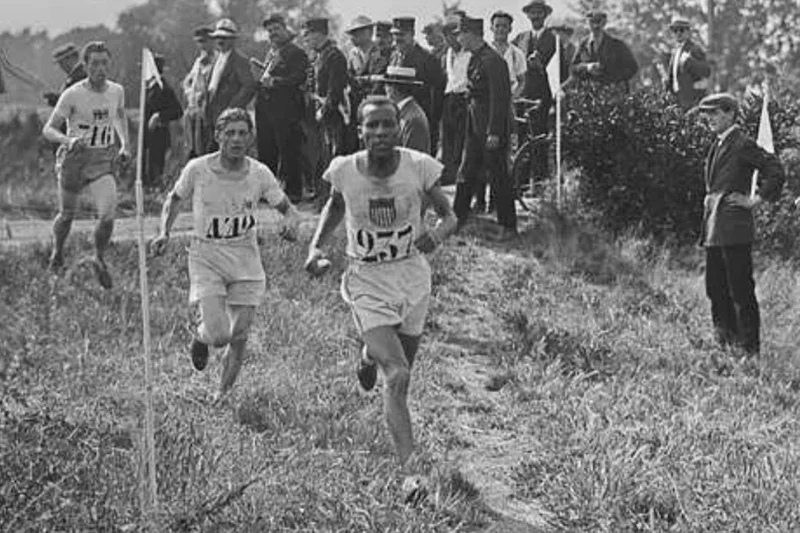
Over the years, we’ve worked closely with the Ted Corbitt Institute to highlight some of the stories of Black running excellence they’ve worked tirelessly to preserve and promote. I’ve long been curious about the story of Earl Johnson, the only American to ever medal in cross country at the Olympics (1924, Paris). But what drew me to his story is that he was from Pittsburgh, my hometown, and was sponsored by the Edgar Thomson Steel Works (my grandfather and father both worked in the Pennsylvania steel mills). Here, project director Sarah Franklin shares the story of Earl Johnson’s bronze medal at the 1924 Olympics. You can watch video from the race, here.
“On July 11, 1924, cross country harrier R. Earl Johnson won an individual bronze medal and led the United States to a team silver at the Summer Olympics in Paris.
Johnson, who had previously competed in the 10,000 meters at the 1920 Olympics, was the United States’ first two-time Black Olympian, and his 1924 cross country triumph made him the first African-American to medal in an Olympic distance running event.
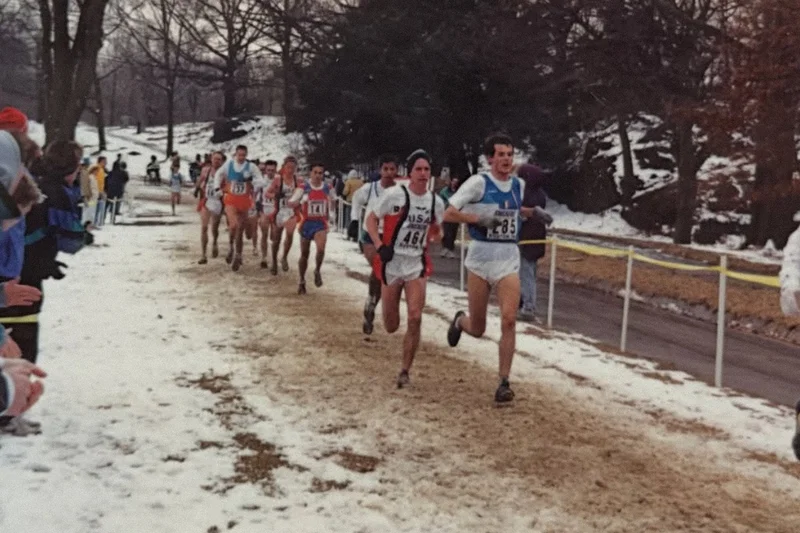
His medal-winning race was held in such punishing heat that 23 of the 38 entrants did not finish. Cross country was subsequently removed from the Olympic schedule, and, to this day, the World Athletics Cross Country Championships – including the 2026 edition this Saturday in Tallahassee, FL – are contested in the winter or early spring.
On that stifling July day in 1924, Johnson managed both the heat and a challenging course, which, as shown in video footage of the race, included a waist-high stone wall, knee-high bramble, and treacherously steep slopes.
In fourth place with less than a kilometer to go, Johnson overtook Britain’s Ernie Harper and stormed into the Olympic stadium with just 300 meters of track separating him from a coveted bronze medal. Prior to cementing his legacy with that performance, Johnson ran for Morgan College before winning the five-mile AAU Junior National Championship in 1918. In 1919, he was recruited to work at and run for the Morgan Community House in Pittsburgh, a church-sponsored recreation center that served many of the city’s Black residents.
In 1921, Johnson took a job as a welfare worker and athletic director at Edgar Thomson Steel, a large steel plant just outside of Pittsburgh that sponsored his running career. Representing Edgar Thomson Steel, from 1921-1924 Johnson won nine total US national championships in cross country, the five-mile, and the ten-mile. Johnson retired from competitive running after his 1924 Olympic achievement and remained active in Pittsburgh’s athletic community until his death in 1965.”