|
|
|
|
| |
|
|
| |
| |
Intensify Drum Excitement with Room Sound
|
|
|
| |
| |
Room sound on drums gives a lively, energetic vibe that can’t be duplicated in any other way. Although Led Zeppelin’s “When the Levee Breaks” is one of the best-known examples of a massive room sound, room sound has always been a vital part of hit recordings throughout the decades.
|
|
|
| |
| |
However, not all drum recording sessions used room mics. What’s more, drum loops often don’t include room sound because it’s assumed you can add artificial ambience during mixdown—but that’s not the same as recording the room sound where the drums were played.
|
|
|
| |
| |
One workaround is to compress the drums, which brings up low-level sounds. Unfortunately, this also reduces peaks, which can rob the drum part of its percussive punch.
|
|
|
| |
| |
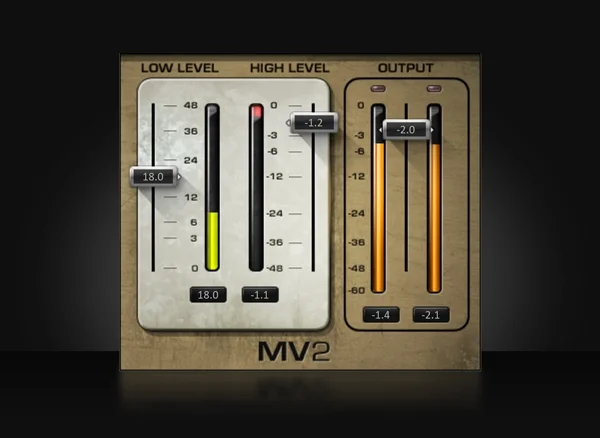
Fortunately, there’s a simple solution: the MV2 dynamics processor, which has two independent compression functions. Like any compressor, it can compress signals above a threshold. What’s unique is its low-level compression feature. This compresses any signal below a threshold upward. So, low level audio like room sounds become more present.
|
|
|
|
|
| |
Setting up the MV2 is super simple. Adjust the two thresholds, one for low levels, and one for high levels:
|
|
|
| |
| |
-
The High Level threshold acts like a standard compressor, and reduces peaks. It has a gain reduction meter. Adjust the threshold for the desired amount of peak compression.
-
The Low Level threshold sets the level below which lower-level audio will be compressed upward. So, its meter shows how much upward compression is being applied.
-
You can use either function, or both.
|
|
|
|
| |
| |
For example, suppose you have a loop of acoustic drums. Because it was mic’d, there will be at least some room sound. Raise the low-level threshold to squeeze out some amount of room sound and hear your drums come to life!
|
|
|
| |