|
|
| |
|
|
| |
| |
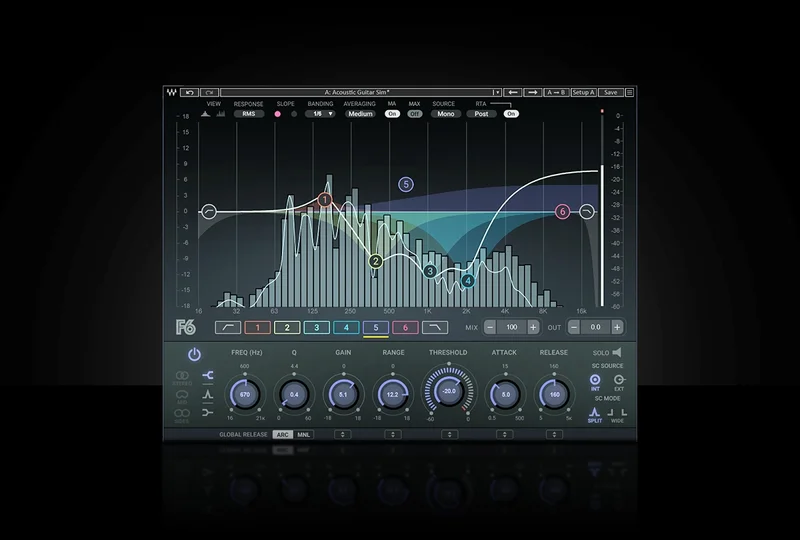
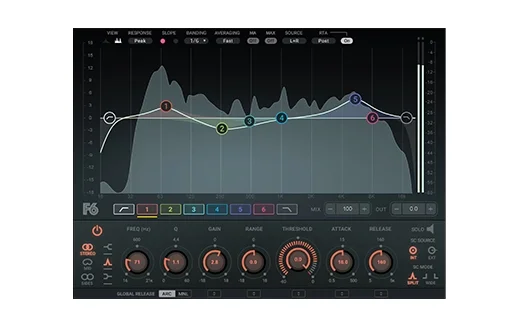
Dynamic EQ can’t make an electric guitar sound exactly like an acoustic guitar that’s recorded direct, but it can come close. The key here is using the F6 dynamic EQ plugin (get the StudioRack preset here) to emulate three acoustic guitar characteristics missing from electric guitars. Even if you do have an acoustic guitar, doubling its part using this technique will add a lively, complementary timbre.
|
|
|
|
|
| |
Bass: Playing harder “excites” an acoustic guitar body’s low-frequency resonance. F6’s Band 1 uses dynamic EQ so that playing harder increases the amplitude around 155 Hz. This adds a full, dynamically responsive depth.
|
|
|
| |
| |
Midrange: Bands 2, 3, and 4 use static EQ. They dip the midrange to more closely follow an acoustic guitar’s frequency spectrum.
|
|
|
| |
| |
Treble: Stage 5’s high-frequency shelving EQ responds to dynamics. Playing harder makes the sound brighter. This is a crucial part of an acoustic guitar’s character.
|
|
|
| |
| |
Note that the input level influences how dynamic EQ responds. With too low a level, the F6 won’t respond to dynamics. With too high a level, even soft playing will boost the dynamic EQ stages. Ideally, your hardest strumming should boost the treble so that it just hits the top of its available range.
|
|
|
| |
| |
Guitars with single-coil pickups give the best simulation. With two pickup models, use the middle pickup switch position. On triple-pickup guitars, try all the combinations to determine the best result. However, even with humbucking pickups, this tip provides an acoustic-like vibe—whether you need that authentic sound for a main guitar part, or simply to double a part to add an interesting, lively acoustic guitar-like timbre.
|
|
|
| |
|
|
| |