|
|
| |
|
|
| |
| |
A piano’s bass strings are typically around 2.5 meters long, and under considerable tension. Because an electric bass has shorter strings, which are also under less tension, tuning instability becomes an issue. So, electric bass trades off tuning stability for an instrument that doesn’t require a 2.5-meter neck—or a 4-meter-tall human to play it.
|
|
|
| |
| |
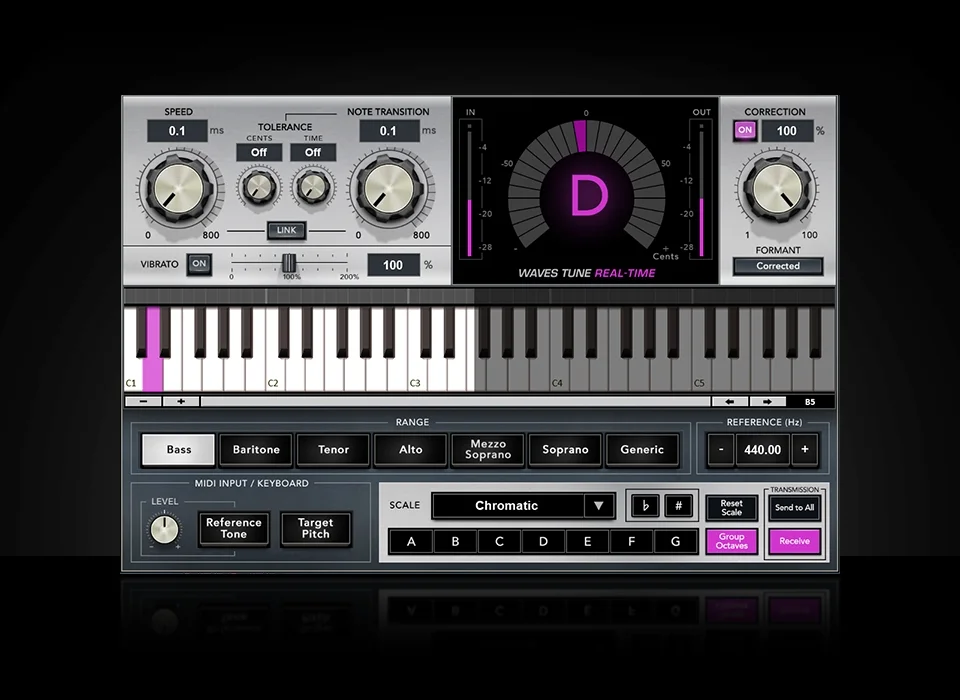
Fortunately, there’s an easy, automatic way to experience piano-like tuning stability with bass. Because Waves Tune Real-Time is designed for vocals, it’s optimized for monophonic audio and quantizing pitch to semitones. So, bass is an excellent candidate for Waves Tune Real-Time pitch correction. Like vocals, bass lines are generally monophonic, and frets being in chromatic steps lend themselves to hard pitch correction.
|
|
|
| |
| |
To add real-time “virtual tuning stability” to bass, use the following Waves Tune Real-Time settings.
|
|
|
|
|
| |
As to whether this makes an audible difference, there’s an easy way to prove it to yourself. Patch your bass to two DAW channel inputs. Insert Waves Tune Real-Time in one of the channels. As you play, you’ll hear chorusing that represents the difference between the bass’s unprocessed tuning and the correct tuning through Waves Tune Real-Time.
|
|
|
| |
| |
The bottom line is that when recording in the studio or playing live, you’ll experience accurate bass tuning that’s simply not possible to obtain otherwise.
|
|
|
| |
| |
This tip courtesy of Craig Anderton.
|
|
|
| |
|