

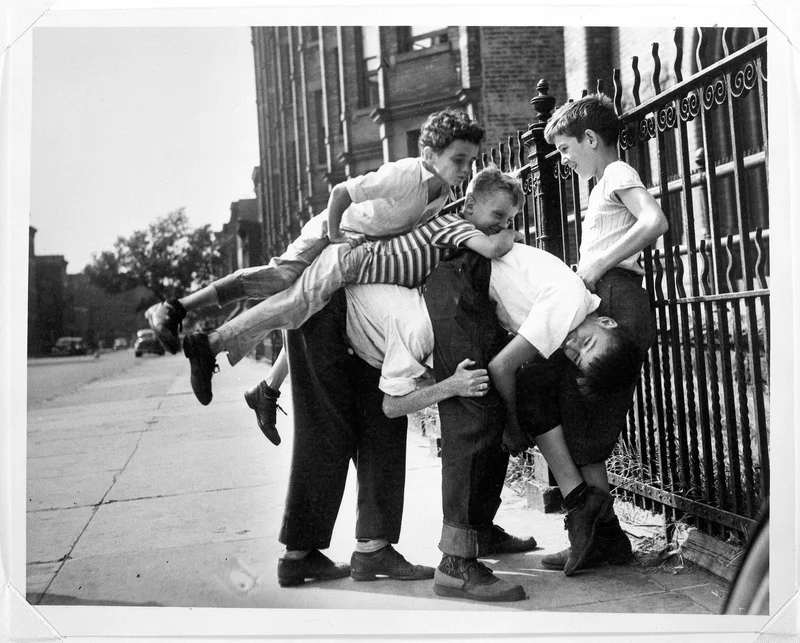
Growing up in New York City provides an unofficial second education. As historian Deborah Dash Moore notes, “urban living fosters a sense of awareness about people and place.” Between the Great Depression and the mid-20th century, a generation of street photographers applied knowledge from this “second education” to their images, many of which center on children. These works are part of a tradition of street photography that spotlights childhood playtime on the streets and sidewalks of New York City—a tradition we can trace through images in the Brooklyn Museum’s collection.
Aaron Siskind
Public school teacher Aaron Siskind joined the Photo League in 1936 and helmed “The Harlem Document” (1932–40). This collaborative project between Siskind, other Photo League photographers, the Federal Writers Project, and Black sociologist Michael Carter represented Harlem residents in their domestic life, work life, and social organizations.
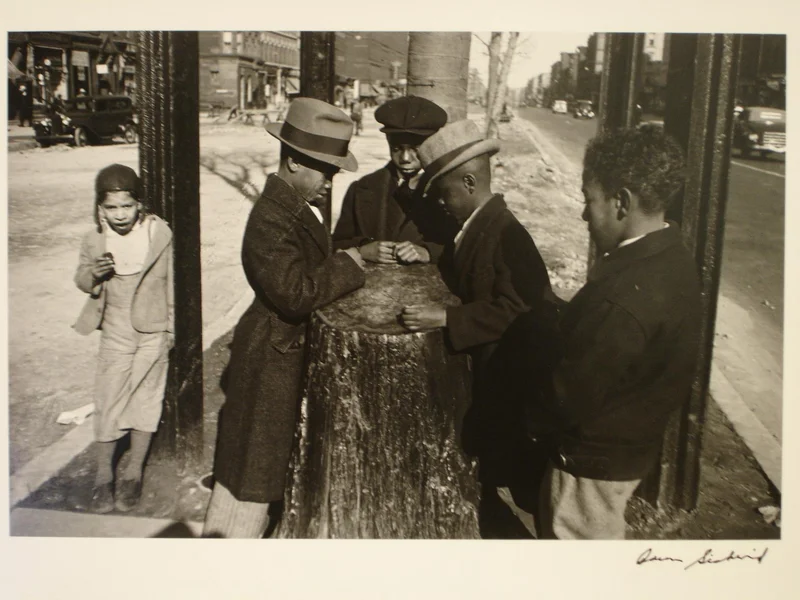
Siskind also photographed Harlem children at play. In Wishing Tree, three boys surround a tree stump; one boy looks on as a girl stands against a pole and faces Siskind’s camera. Wedged on an island between two streets, the boys’ eyes are obscured from the viewer as they study the stump and its endless narrative possibilities. Siskind’s photograph calls attention to the lives of Harlem’s youngest residents as they carve out a space for themselves.
Arthur Leipzig
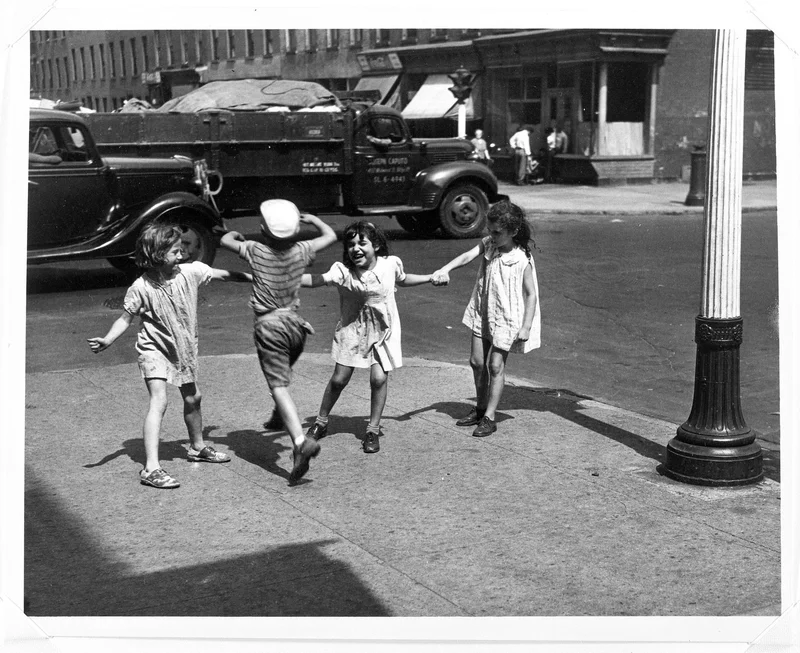
In Rover, Red Rover, four children smile and laugh while playing the titular game. Arthur Leipzig foregrounds the children as the point of action and emotional tenor on an otherwise unremarkable New York City corner. With their arms linked and the sun shining on them, the children’s fluidity counters the rigidity of the buildings, cars, and adults in the background.
Vivian Cherry
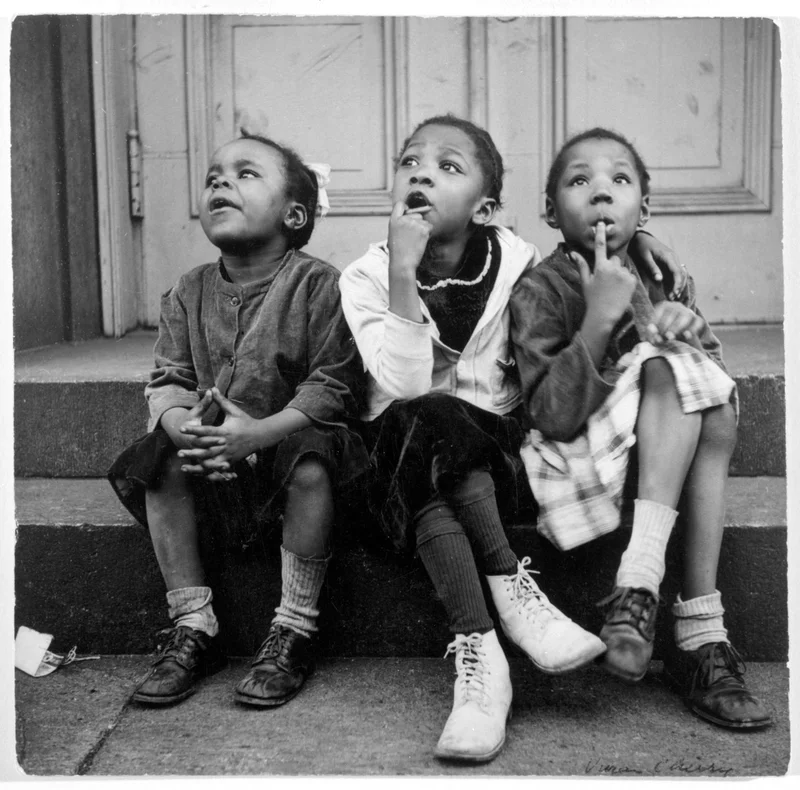
Photographer Vivian Cherry joined the Photo League in the late 1940s. Initially a Broadway and nightclub dancer, Cherry became a photographer after working as a darkroom technician. In Harlem, Watching a Sky Writing Plane, Cherry’s experience with performance shows as she directs our attention to the three girls, who are as attentive as an audience watching a show. Sitting on a step in scuffed shoes, with trash on the corner and a dirty door behind them—the girls stare upward; their eyes reveal that each girl is engrossed by a distinct part of the skywriting. The photograph echoes Siskind’s Wishing Tree in that the children are transfixed in wonder.
From the top: Arthur Leipzig. Johnny on the Pony, 1943. Gelatin silver print. Brooklyn Museum, Gift of the artist, 86.152.7. © Arthur Leipzig. (Photo: Brooklyn Museum); Aaron Siskind. Wishing Tree, ca. 1937. Gelatin silver print. Brooklyn Museum, Gift of Dr. Daryoush Houshmand, 1989.193.8. © Aaron Siskind. (Photo: Brooklyn Museum); Arthur Leipzig. Rover, Red Rover, 1943. Gelatin silver print. Brooklyn Museum, Gift of the artist, 86.152.8. © Arthur Leipzig. (Photo: Brooklyn Museum); Vivian Cherry. Harlem, Watching a Sky Writing Plane, 1952. Gelatin silver print. Brooklyn Museum, Purchased with funds given by the Horace W. Goldsmith Foundation, Harry Kahn, and Mrs. Carl L. Selden, 1994.31.1. © Vivian Cherry. (Photo: Brooklyn Museum)


