Lindsay’s productivity spotlight: Objectives & Key Results
This year, I’m on a mission to test-drive some fresh productivity methods.
Each month, I'll explore a different approach for a few weeks and then share all the details of my experience.
About Objectives & Key Results (OKR)
For this month’s productivity method, I wanted something that would help me align my work with bigger goals. Enter Objectives and Key Results.
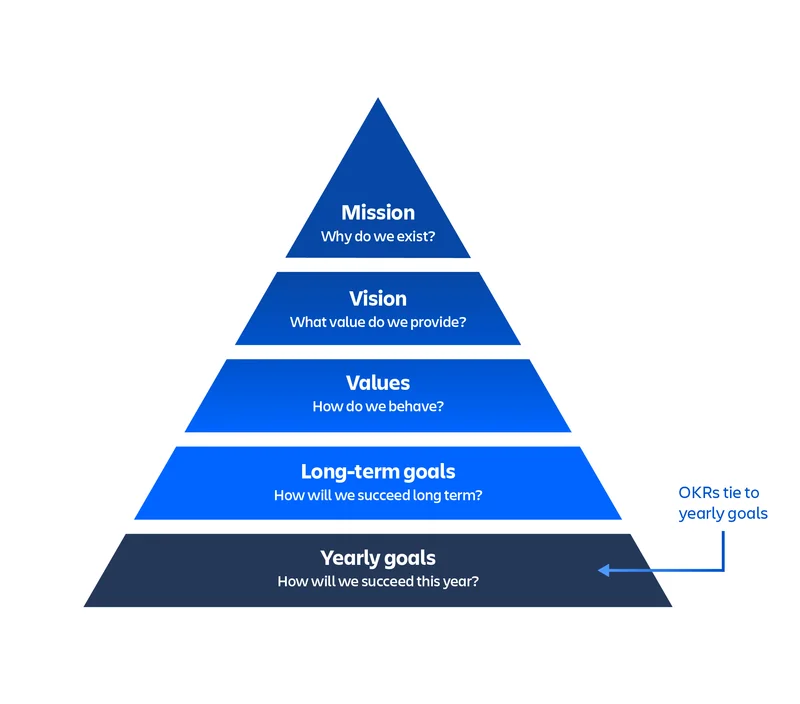
OKRs are a goal-setting framework used by companies like Google and LinkedIn, but they can also work for personal productivity.
The method encourages you to define big, ambitious goals (Objectives) and then break them down into measurable outcomes (Key Results) that will help you achieve them.
The concept: The Objective is the "what.” What you want to achieve. It should be inspiring and challenging.
The Key Results are the “how.” Specific, measurable actions that will get you to the finish line. Ideally, there should be 3-5 key results for each objective, and they should be quantifiable so you can track your progress.
The goal: By combining aspirational objectives with concrete key results, OKRs help you stay focused on the most important things and give you a clear way to measure your progress.
You can learn more about it on Todoist’s blog post or Atlassian’s blog post.
Setting my OKRs
I was excited to test this method because it seemed like a great way to bring clarity and structure to my work, especially when juggling long-term goals with day-to-day tasks.
What was I aiming for? My main goal this month was to increase both my personal and professional development. To break that down into OKRs, I set an ambitious objective: "Improve my overall productivity and learning."
- From there, I identified key results like:
- Complete two online courses relevant to my role.
- Finish reading one personal development book.
- Reduce the time spent on low-priority tasks by 20%.
The first step was setting up my OKR tracker. I used a simple spreadsheet to list my objectives and key results, with space to note my progress weekly.
The first week went pretty smoothly. I had a clear vision of what I needed to accomplish, and tracking key results gave me that extra nudge of motivation. It was great to see progress in real-time.
But as the weeks went on, I ran into some challenges. One issue was that my key results were a bit too rigid. For example, reducing time spent on low-priority tasks was harder to measure than I anticipated, and I found myself getting a little too focused on just checking off boxes. I also had to balance the aspirational aspect of my objective with realistic daily goals, which wasn’t always easy.
To address this, I made a few tweaks. I adjusted my key results to be more flexible and actionable, such as tracking time spent on meaningful work rather than just cutting down on low-priority tasks. I also learned that it’s okay to revise your OKRs midway through, which helped relieve some of the pressure.
By the end of the month, I was happy with how much I had accomplished, even if I hadn’t nailed every key result. The big takeaway for me was how OKRs pushed me to think more strategically about my goals and kept me accountable throughout the month.
I’m definitely going to use this method moving forward, especially when tackling larger projects.
Overall, my experience with OKRs was both challenging and rewarding. It’s a method that requires some planning upfront, but the clarity it brings to your work is worth it. While it took a bit of trial and error to fine-tune my key results, I came away with a better understanding of how to set and achieve meaningful goals.