

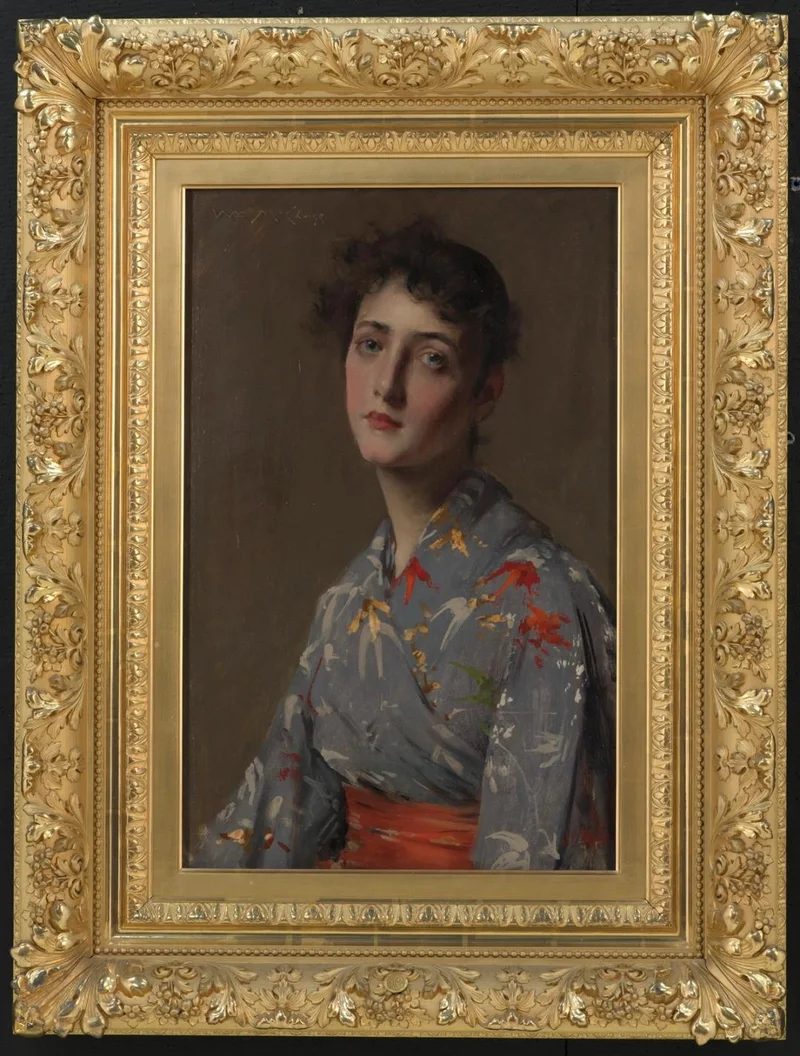
Orientalism, the Male Gaze, and Girl in a Japanese Costume
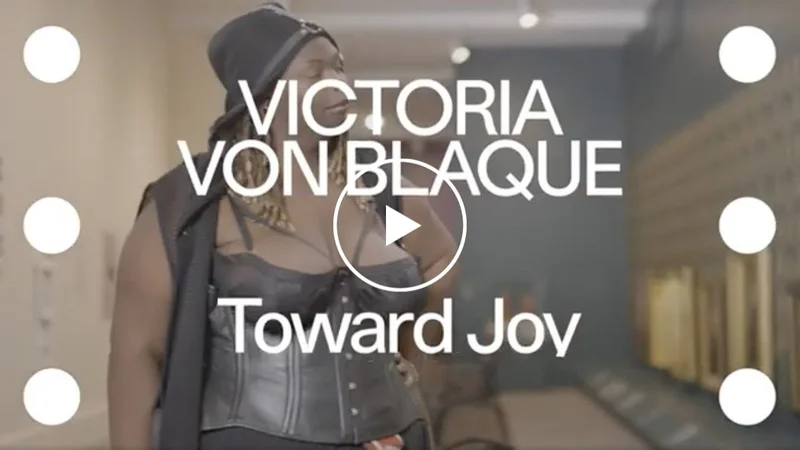
In Toward Joy, the Brooklyn Museum’s transformed American Art galleries, art and objects are organized into distinct frameworks. “Several Seats” offers a new way of engaging with historic seated portraits. Inspired by “have several seats,” a phrase that emerged from New York City ballroom culture, this framework includes “reads” from local drag and ballroom artists who offer clever and incisive critique in many of the wall labels.
Below, read how Brooklyn-based drag queen Emi Grate spilled the “T” in her label for William Merritt Chase’s Girl in a Japanese Costume.
Working and teaching in New York City in the late 1800s, American Impressionist painter William Merritt Chase subscribed to America’s then-newfound fascination with Japanese arts and culture (Japonisme)—an early “weeaboo,” if you will. This new trend of Japonisme was made possible thanks to Western imperial and military pressures; in 1853, just three years after the annexation of California, America became the first of the Western powers to force Japan to open up for foreign trade after over 200 years of Japanese isolationism. America and Europe welcomed an influx of Japanese artifacts, the aesthetics of which were incorporated into the arts, and Japan received an influx of foreign currency, which destabilized its economy.
On a first look at Chase’s painting Girl in a Japanese Costume, we may recognize the “Japanese costume” in the painting as a kimono. Birds, trees, and flowers are common visual motifs on kimonos. They’re often worn with white or solid-color undergarments, which are visible around the neckline. The front closure of the kimono goes left over right, and it is tied at the waist with an obi (sash). There is also a casual kimono variation called the yukata, which is worn in the summer, at bathhouses, and without undergarments. Here, the model wears no undergarment, and the closure goes right over left, which is more standard in Western clothing. The details on the kimono and obi are indiscernible due to Chase’s Impressionist brushstrokes.
Let’s examine this artwork through the frameworks of Orientalism and the male gaze. In his 1978 magnum opus of literary criticism, Orientalism, Palestinian American philosopher Edward Said observes that the Occident (West) creates representations of the Orient (East) because it assumes the East is unable to present or represent itself. In the process, the “Oriental” subject loses its original value and meaning while being assigned new and perhaps incongruent ones by an outsider.
From the top: William Merritt Chase. Girl in a Japanese Costume, ca. 1890. Oil on canvas. Brooklyn Museum, Gift of Isabella S. Kurtz in memory of Charles M. Kurtz, 86.197.2. (Photo: Brooklyn Museum)
Toward Joy: New Frameworks for American Art is organized by Stephanie Sparling Williams, Andrew W. Mellon Curator of American Art; Caroline Gillaspie, Assistant Curator of American Art; Catherine Futter, Director of Curatorial Affairs and Senior Curator of Decorative Arts; Liz St. George, Assistant Curator, Decorative Arts; Nancy Rosoff, Andrew W. Mellon Senior Curator, Arts of the Americas; and Dare Turner, Curator of Indigenous Art; with Grace Billingslea and Michael Gibson-Prugh, Curatorial Assistants, Arts of the Americas and Europe.
This exhibition is made possible through support from the Terra Foundation for American Art.
Leadership support for this exhibition is provided by Tracey and Phillip Riese. Major support is provided by American International Group, Inc.; Saundra Williams-Cornwell and W. Don Cornwell; Pfizer, Inc.; and the Brooklyn Museum Council for African American Art. Generous support is provided by Lizanne Fontaine and Robert Buckholz, the Hasso Philanthropic Foundation, the National Endowment for the Humanities, and Nkonye Okoh. Additional support is provided by Barbara Madsen Smith, Barbara F. and Richard W. Moore, Ruthard C. Murphy II, and Ellie Meek Tweedy and David Tweedy.


