


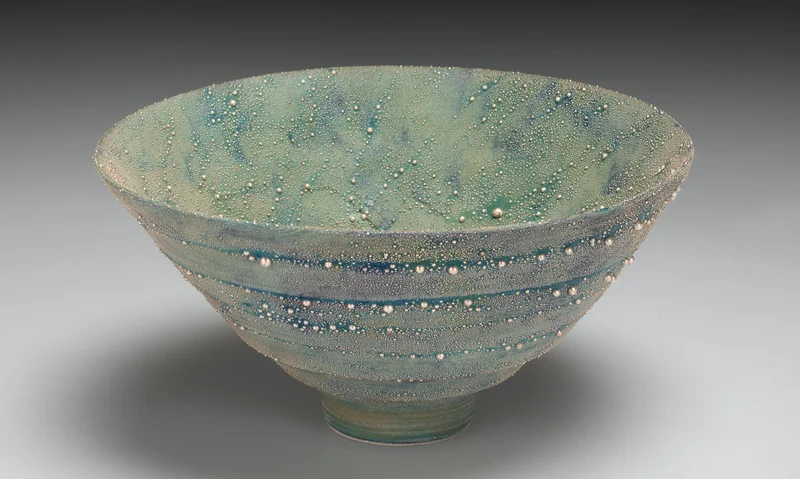
This Father’s Day, we’re thinking about artistic lineages. How do you build on what came before you?
Legacy is a major theme in Porcelains in the Mist: The Kondō Family of Ceramicists, the Brooklyn Museum’s current installation featuring ceramic objects by Kondō Takahiro and his family.
The idea of legacy in the arts is tricky for both the artist-inheritors and the critics who assess their work. How much does it matter who an artist’s teacher or parent was?
In traditional Japanese art, and especially in the field of ceramics, it was common for senior artists to pass elements of style and trade secrets down to young talents—many of whom adopted the teacher’s family name even if they weren’t related.
This system has ensured the survival of several types of ceramic production, but at times it has stifled creativity, as students feel pressure to emulate their mentors rather than investigate new approaches.
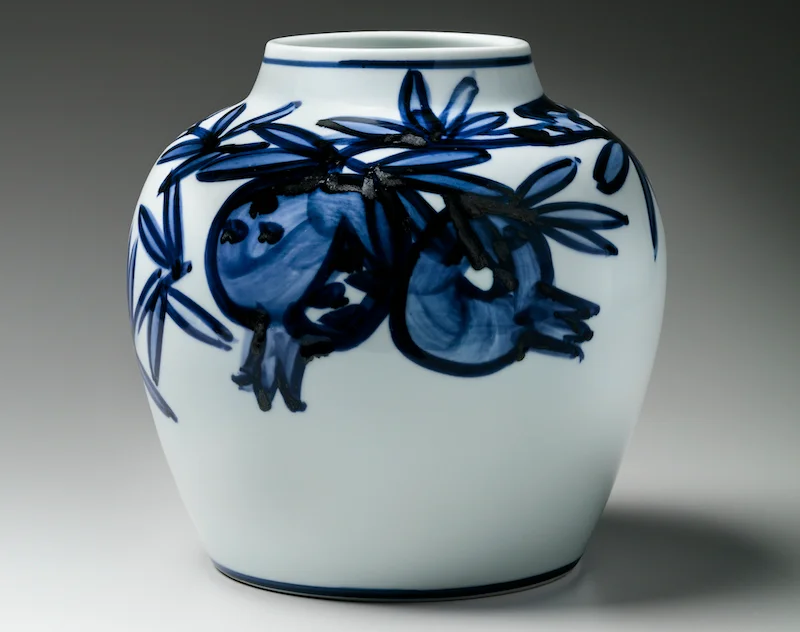
Our journey begins with ceramicist Kondō Yūzō, who was designated a Living National Treasure in Japan for his work in blue-and-white porcelain.
During Yūzō’s time, cobalt-decorated porcelain was mass-produced and found everywhere. But Yūzō breathed new life into an old medium, wheel-throwing his own jars and painting them in bold, loose designs that were full of personal expression.
As the first ceramicist in his family, Kondō Yūzō was completely free to choose his own medium and find his own style. The next generation had to grapple with being the sons of a genius.
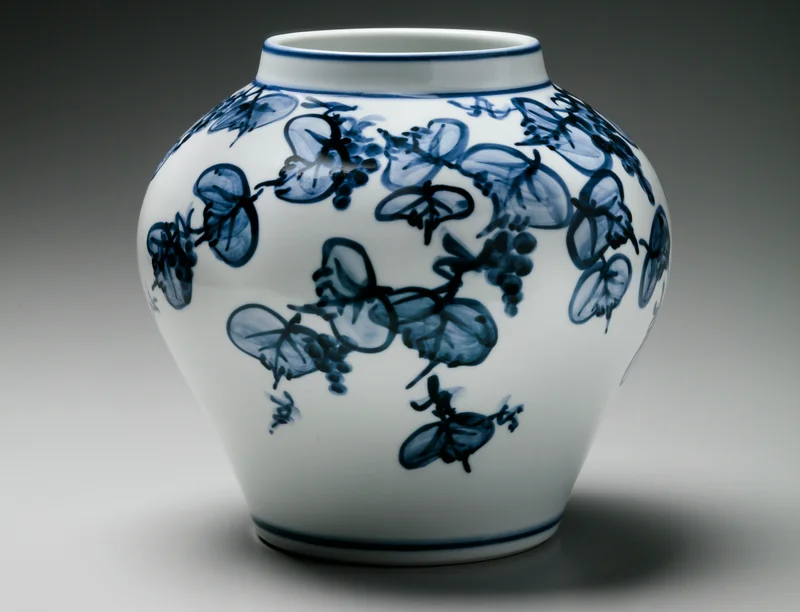
Kondō Hiroshi followed closely in his father’s footsteps. He was skillful as a painter, but he would always be known as the inheritor of the Kondō style.
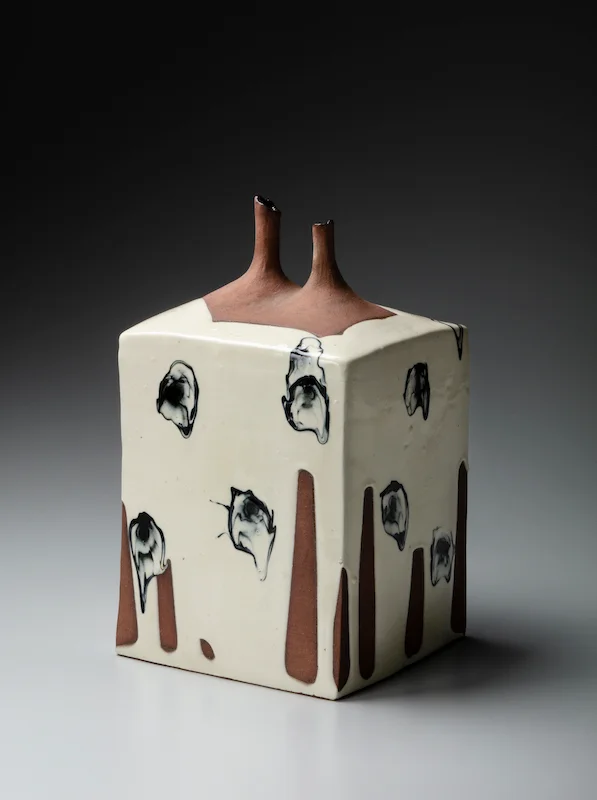
Meanwhile, his brother, Kondō Yutaka, chose to take an entirely different path within the world of ceramics. His more sculptural vessels are in red stoneware, which is sometimes left exposed under black or white glaze. Yutaka was part of an international mid-century modern ceramics movement. He left a legacy to his nephew, Takahiro, by paving the way for further experimentation.
Takahiro is careful to distance himself from the “potter family” model. (In fact, he had an earlier career as a table tennis player!)
When he decided to go into the family trade, he quickly found his own approach, namely a special glaze that beads up to look like metallic rain drops. He calls the effect gintekisai, or silver mist. When applied to the human form, it recalls perspiration.
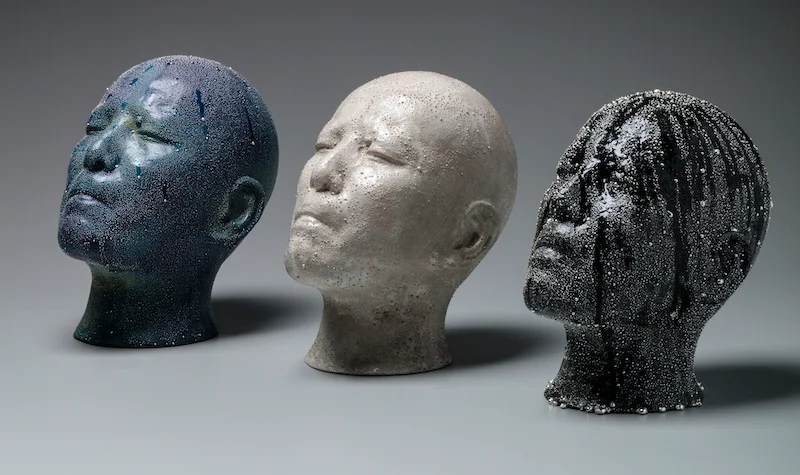
As he approached 50, Takahiro started making casts of his own head, taking his work in a new, very personal direction.
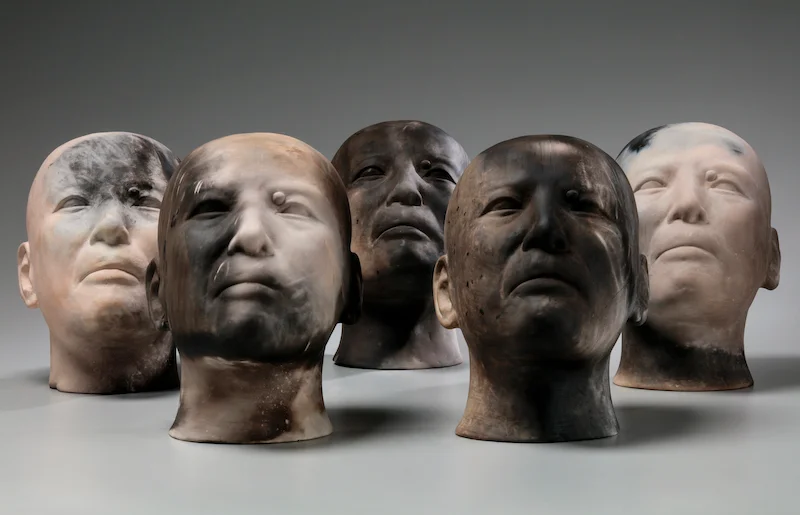
One particularly potent group of heads was fired using an ancient technique in which the clay objects are placed in a pit beneath a pile of green branches that are lit for a slow, smoky burn. Takahiro has spoken about the experience of retrieving the heads from the ashes as a kind of rebirth. It’s a fitting image: after all that is inherited, ultimately, the artist has the power to remake himself.
Brooklyn Museum
200 Eastern Parkway
Brooklyn, NY 11238


From top: Kondō Takahiro (Japanese, born 1958). Silver Mist Colors Tea Bowl, 2013. Glazed porcelain, 2 15/16 × 6 1/4 × 6 1/4 in. (7.5 × 15.8 × 15.8 cm). Carol and Jeffrey Horvitz Collection. © Kondō Takahiro. (Photo: Richard P. Goodbody and John Morgan); Kondō Yūzō (Japanese, 1902–1985). Flower Vase with Pomegranates, circa 1960. Glazed porcelain, 10 1/8 × 10 1/4 in. (25.8 × 26 cm). Carol and Jeffrey Horvitz Collection. (Photo: Richard P. Goodbody and John Morgan); Kondō Hiroshi (Japanese, 1936–2012). Jar with Grapevine, circa 2009. Glazed porcelain, 9 1/16 × 9 7/16 × 9 7/16 in. (23 × 24 × 24 cm). Carol and Jeffrey Horvitz Collection. (Photo: Richard P. Goodbody and John Morgan); Kondō Yutaka (Japanese, 1932–1983). Dripping Ink Jar, 1964. Glazed stoneware, 12 3/16 × 7 1/2 × 6 11/16 in. (31 × 19 × 17 cm). Carol and Jeffrey Horvitz Collection. (Photo: Richard P. Goodbody and John Morgan); Kondō Takahiro (Japanese, born 1958). Three pieces from the series Reflection: TK Self Portrait, 2010. Glazed porcelain, each piece, 9 7/16 × 6 5/8 × 8 11/16 in. (24 × 16.8 × 22 cm). Carol and Jeffrey Horvitz Collection. © Kondō Takahiro. (Photo: Richard P. Goodbody and John Morgan); Kondō Takahiro (Japanese, born 1958). Reflection: TK Self Portraits, 2010. Glazed porcelain, each piece, 9 7/16 × 6 7/8 × 9 7/16 in. (24 × 17.5 × 24 cm). Carol and Jeffrey Horvitz Collection. © Kondō Takahiro. (Photo: Richard P. Goodbody and John Morgan)
Porcelains in the Mist: The Kondō Family of Ceramicists is organized by the Brooklyn Museum based on the exhibition Transcendent Clay/Kondo: A Century of Japanese Ceramic Art, originally presented by the Lowe Art Museum, University of Miami, and guest curated by Joe Earle. The Brooklyn Museum’s presentation is organized by Joan Cummins, Lisa and Bernard Selz Senior Curator, Asian Art.
We are grateful to Carol and Jeffrey Horvitz, whose generosity and enthusiasm made this exhibition possible.


